2Chat has a good reputation, and it has earned it. It holds a 4.5 out of 5 on Trustpilot across 34 reviews, with about 94 percent of them five-star, and the praise is specific: support that answers quickly, a setup that takes a few clicks, and integrations with Make, Zapier and HubSpot that work. One reviewer described the support team helping with a problem at their file host, which was nothing to do with 2Chat. That is not what a product with a support problem looks like.
So the reason to look for an alternative is not quality. It is fit. 2Chat is built as a platform, and a developer who wants raw API access is buying more platform than they need.
What 2Chat is, in its own words
2Chat connects a WhatsApp or WhatsApp Business number by QR code through Linked Devices, then exposes it over a REST API and webhooks. Its own materials compare it directly with open-source libraries like Baileys, whatsapp-web.js and whatsmeow, and the pitch is the one every hosted provider makes: no server to run, protocol changes absorbed for you, no maintenance windows. The same pages note that automating regular WhatsApp numbers is not officially supported by WhatsApp, and offer an official route through Meta's Embedded Signup for customers who want it.
Around the API sits a lot more. A shared team inbox, a no-code flow builder, AI agents, audio transcription, bulk messaging, virtual phone numbers across more than 90 countries, and a JavaScript SDK for embedded voice calling. For developer tooling there is an OpenAPI spec, a Postman collection and an MCP server. If you are building a white-label product and want your customers to get a WhatsApp layer without seeing any infrastructure, that breadth is the point.
Where it gets expensive for API-only use
Pricing is per connected number. 2Chat's developer page lists hosted numbers at $10 per connection per month, or about $0.33 a day, with volume discounts from ten numbers and custom pricing at twenty or more. Elsewhere the Pro rate is listed as $15 per connected number. The two figures describe different plans and I could not reconcile them from the public pages, so confirm which applies to you before you budget.
Even at the lower figure, the arithmetic is direct:
| Numbers connected2Chat at $10 each2Chat at $15 eachWaHttp | |||
| 1 | $10 | $15 | $5 |
| 3 | $30 | $45 | $12 |
| 6 | $60 | $90 | $22 |
| 10 | $100 | $150 | $35 |
2Chat's volume discounts will narrow the gap at ten numbers, and I do not have the discounted rate, so treat those last rows as upper bounds. The more important difference is what the price includes. With 2Chat, every number you connect carries the platform: inbox, builder, AI agents. If you will never open the dashboard, that is a recurring charge for software you do not use.
I also could not find a statement on 2Chat's public pages about message volume limits or how heavy API use is metered. If you expect to send at scale, ask them directly rather than assume. Our 2026 pricing breakdown explains the flat, per-session and per-message models and where each one wins.
The same risk as every QR-based provider
2Chat connects as a linked device, outside Meta's official Business Platform, and says as much itself. The ban exposure is therefore the same as any session-based provider, flat-rate or not. The honest difference is that 2Chat offers an official Embedded Signup route when your use case needs it, which most pure-API providers do not. For the full trade-off between the two models, our Cloud API versus session-based comparison sets out what you give up and gain on each side.
Where 2Chat is the better choice
If you are an agency or a SaaS builder who wants to resell WhatsApp functionality under your own brand, 2Chat's white-label positioning, virtual numbers and embedded voice calling are real advantages that a plain API does not provide. If your team includes non-developers who will use the inbox and the flow builder every day, the per-number price buys something you will use. And if you may later need the official Business API path from the same vendor, that option is built in. WaHttp has none of these: it is a REST API and webhooks, hosted, and nothing else.
If you want the API and nothing else
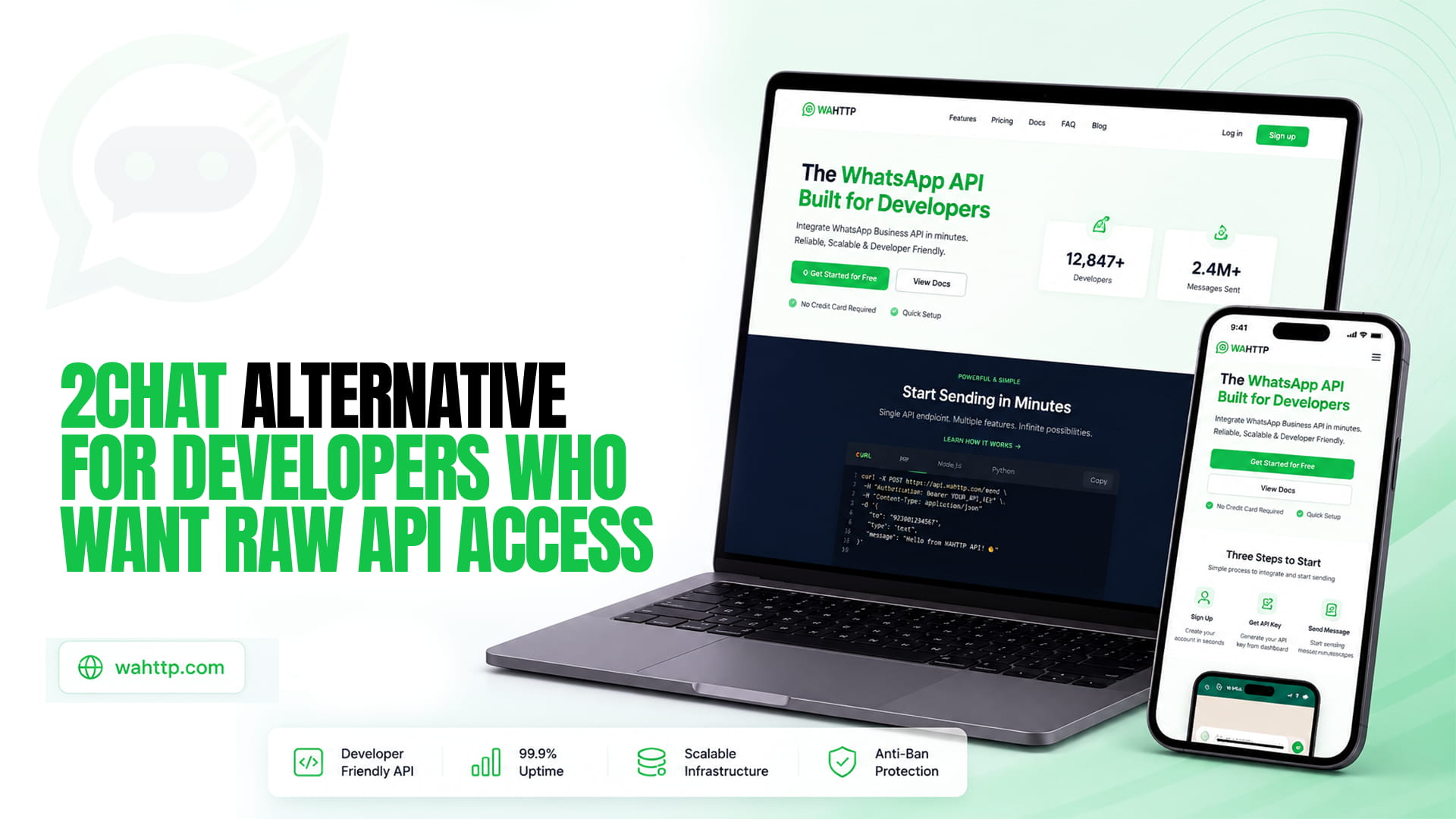
WaHttp is priced per session, not per feature set. One session is $5 a month with unlimited messages, three are $12, six are $22 and ten are $35, with REST endpoints and webhooks on every plan. The webhook guide covers the inbound side, which is the part most integrations spend the most time on.
One point where the two overlap: both offer an MCP server, so an AI agent can send and read WhatsApp messages through either. If that is why you are comparing them, our guide to connecting Claude to WhatsApp over MCP walks through the setup on WaHttp's endpoint. For how the rest of the market prices and positions itself, the provider comparison puts the alternatives side by side.
Choosing
Pick 2Chat if you are reselling, if non-developers will use the inbox and builder, or if you want an official-API option under the same roof, and you are comfortable with per-number pricing. Pick a flat-rate API if you are a developer who wants endpoints and webhooks, you run several numbers, and you would rather your bill not scale with features you are not using. If you are unsure, 2Chat's free trial needs no card, which makes it easy to test whether the extra platform earns its price for your use.
Migration notes
The core calls map across cleanly. Sending a message is a POST with a recipient and a body or media URL on both sides, and number pairing is the same QR scan. Remap your inbound webhook handler to the new payload fields and re-test delivery receipts. What does not move is anything built inside 2Chat's flow builder or inbox, along with purchased virtual numbers, which are tied to their platform. Rebuild those flows in code or in n8n, and plan separately for any virtual number you rely on.