AiSensy's marketing leads with "free WhatsApp Business API," and taken narrowly, that claim is accurate: the Free Forever plan includes API access, a live chat dashboard and contact management at no cost. What it does not lead with, and what matters more if you are building a product rather than running a campaign, is what that free tier does not include. Message broadcasting requires a paid plan. The chatbot builder is a separate add-on running roughly ₹2,000 to ₹2,500 a month on top of whatever plan you are already paying for. The AI agent is another separate add-on, priced by message volume. Pricing throughout is built around agent seats, contact tags and attribute limits, which are CRM constructs, not the units a developer building a product actually scales against.
None of that makes AiSensy bad. It makes it a campaign and CRM platform with API access as an entry point, aimed squarely at Indian SMBs running WhatsApp marketing without an engineering team, which is exactly who its pricing page is written for. If you are that buyer, skip to the section on when AiSensy is the right call. If you are a developer who wants the API to be the product rather than a feature bolted onto one, the rest of this is for you.
What "free API" actually gates
Broadcasting is not on the free tier. Sending a campaign to a contact list, the single most basic marketing action on the platform, requires upgrading to Basic at roughly $45 a month, or around ₹1,500 for Indian accounts. The free tier's API access lets you connect and message individually, but the thing most people actually came for sits behind the paywall.
Chatbots and AI agents are separately metered add-ons. A no-code chatbot builder runs about ₹2,000 to 2,500 a month for five flows, on top of your base plan. A conversational AI agent is priced separately again, around ₹1,350 a month for 1,000 AI messages, or roughly $16, with additional usage billed further. If your plan is to build an AI-driven WhatsApp assistant, you are stacking three charges: the base subscription, the AI add-on, and Meta's own per-message fee, before writing a line of code.
Pricing scales by seat and by CRM object, not by usage. Basic includes one owner and five agents, with extra agents priced at roughly $20 each, around ₹750 to 800. Tag and attribute limits expand by tier: 10 tags and 5 attributes on the free plan, up to 100 tags and 20 attributes on Pro. Those are meaningful constraints for a marketing team managing segments and campaigns. They are close to meaningless for a developer whose actual constraint is messages sent, numbers connected or API throughput, none of which this pricing model prices directly.
The markup, quantified
AiSensy publishes ₹1.09 per marketing message for Indian recipients. Meta's own rate for the same message is ₹0.8631. That gap, a markup of roughly 26 percent on top of Meta's own fee, is the platform's actual take on every promotional message you send, on top of whatever subscription tier you are already paying. It is a more precise number than most BSPs publish, credit to AiSensy for that, but it is also a real cost that compounds with volume in a way the advertised plan price does not communicate.
The geography problem
This is the detail that matters most if you are outside India specifically. AiSensy's USD-denominated pricing page lists Basic at $45 and Pro at $99. Converted at market exchange rates, the equivalent India-market pricing in rupees works out to roughly 2.5 times less for the same tier. That is not a currency-drift issue like a ruble or real-denominated competitor; it is a deliberate two-tier pricing structure where international buyers pay a substantially higher effective rate for identical functionality. Worth knowing before you compare AiSensy's dollar price against a competitor's, since the number on the page is not the number an Indian customer pays for the same plan.
What AiSensy does well
To be fair, because the picture above is specifically about developer fit rather than overall quality: AiSensy's free tier is genuinely generous for basic use, with unlimited chats and API access at no cost, which is more than several competitors offer. Its INR pricing is aggressive and clearly aimed at making WhatsApp marketing accessible to small Indian businesses that would otherwise not afford an official BSP. Dialogflow integration, Shopify and WooCommerce connections, and a 14-day free trial round out a product that reviewers consistently rate well for its intended audience. If you are an Indian SMB wanting a no-code campaign and CRM platform with WhatsApp built in, AiSensy is doing its job.
What genuinely API-first looks like
The test is simple: does the pricing model care how you use the API, or only that you have access to it? A developer platform prices on usage, messages, sessions or API calls, not on how many teammates have a login or how many CRM tags you have created. It includes webhooks and full API functionality on every tier, not gated behind an upgrade. And it does not require you to separately license a chatbot builder or an AI layer to use the messaging capability you are already paying for, because those are your code to write, not a feature to rent.
If you need to stay on Meta's official platform. Gupshup is the direct comparison worth making, since it also targets Indian and Southeast Asian markets specifically, with markups from $0.001 to $0.004 per message and monthly platform fees from $10 to $80, considerably more transparent than a fixed per-message rupee markup layered under CRM-tier pricing. Twilio and 360dialog are the international equivalents: no seat pricing, published markup, webhooks included from the first plan. Our pricing breakdown has the full country-by-country rate card if you want to model official-platform costs properly before choosing a BSP.
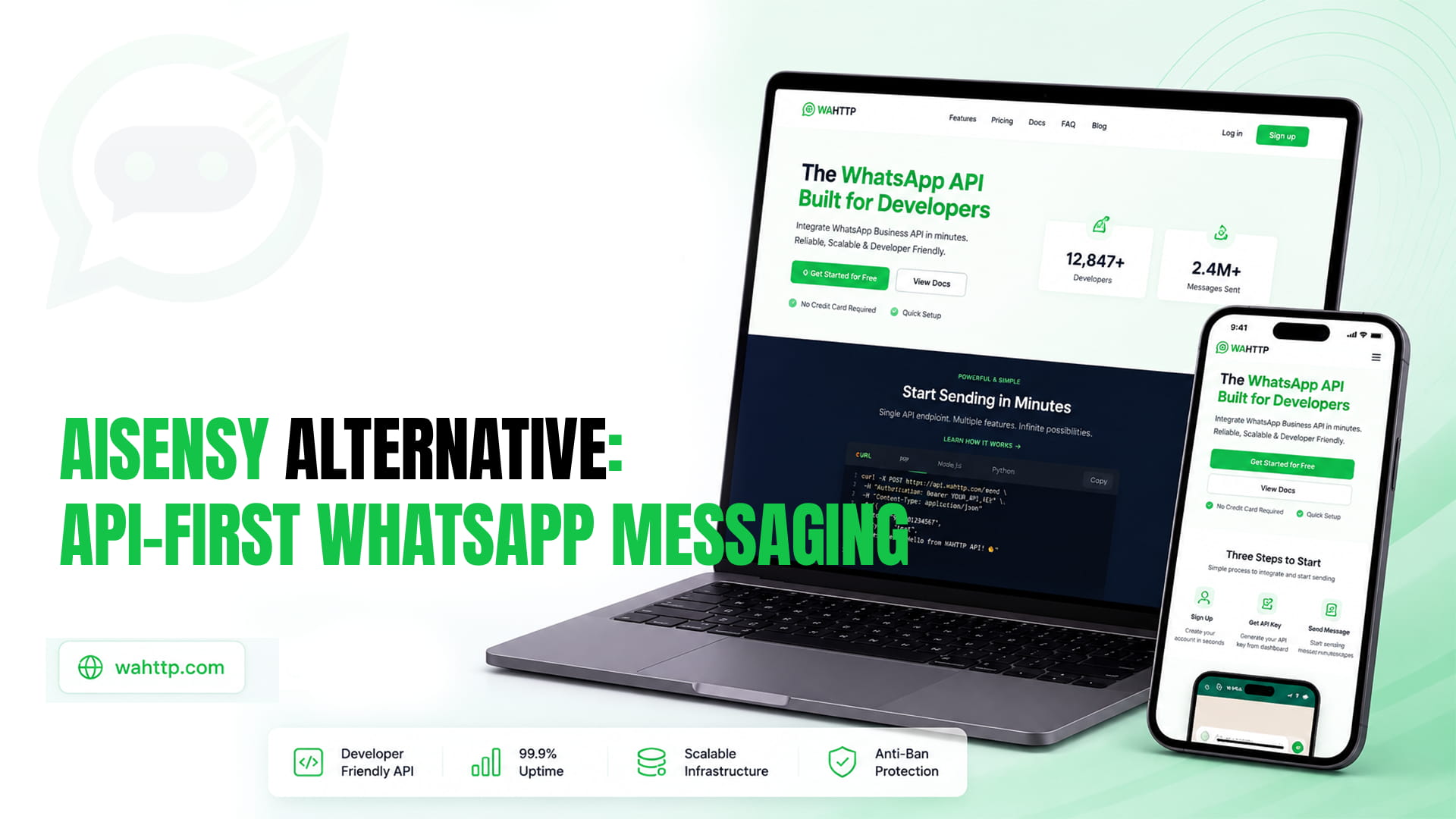
If you do not need Meta approval at all. Session-based APIs remove the seat model, the tag limits and the add-on menu entirely. WaHttp runs $5 to $35 a month for one to ten sessions, unlimited messages, full webhook access from the first plan, and a Streamable HTTP MCP endpoint if you are building an AI agent yourself rather than renting one as an add-on. WasenderAPI is similarly priced with official SDKs. Neither requires Business Verification or a WABA, which also means neither offers AiSensy's blue tick assistance or official compliance standing. Our comparison of the two categories covers that trade-off in full.
Side by side, for a developer specifically
| AiSensy BasicAiSensy ProGupshupWaHttp | ||||
| Base price (USD) | $45/mo | $99/mo | $10–80/mo | $5–35/mo |
| Broadcasting on entry tier | No, Basic required | Yes | Yes | N/A, no templates |
| Chatbot builder | Paid add-on, ~$24/mo | Paid add-on | Not bundled, build your own | Not bundled, build your own |
| AI agent | Paid add-on, ~$16/mo + usage | Paid add-on | Not bundled | MCP endpoint included |
| Pricing model | Per seat, per CRM tag tier | Per seat, per CRM tag tier | Per message markup | Flat, per session |
| Published message markup | ~26% (₹1.09 vs ₹0.8631) | ~26% | $0.001–0.004/msg | None, flat pricing |
| Webhooks | Included | Included | Included | Included, all tiers |
| Meta approval required | Yes | Yes | Yes | No |
| Geography pricing gap | ~2.5x for USD buyers | ~2.5x for USD buyers | Consistent | Consistent |
When AiSensy is still the right call
If you are running WhatsApp marketing for an Indian SMB, want a CRM with tags and segments, and would rather configure a chatbot than write one, AiSensy's INR pricing is genuinely competitive and the product is well reviewed for exactly that use case. The seat and tag-based pricing that reads as friction to a developer is a sensible fit for a team managing customer relationships rather than shipping code. This article is not an argument that AiSensy is poorly built; it is an argument that its shape does not match a developer's requirements, and the two audiences want fundamentally different things from a pricing page.
Migration notes
If you have been calling AiSensy's raw API directly rather than using its chatbot or campaign tooling, migrating your send and webhook logic is straightforward: the underlying shapes, a recipient, a message type, a body, an inbound event, are conceptually the same across any competitor. What takes longer is anything built inside AiSensy's chatbot flows or Dialogflow integration, since that logic lives inside their platform with no direct export, and rebuilding it in code is real work worth budgeting for separately rather than assuming it ports automatically.
If part of your operation genuinely needs the CRM and campaign layer, consider keeping AiSensy, or a comparable platform, for that function specifically, while building your product's own messaging separately on a developer-first API. The two do not have to share a number or a platform, and forcing one tool to do both jobs is usually where the friction in this comparison actually comes from.
Common Questions
Is AiSensy's WhatsApp API actually free? API access and basic connectivity are included on the Free Forever plan, but broadcasting, campaign tools and the chatbot builder all require a paid plan or a separately priced add-on. Meta's own per-message fees, plus AiSensy's markup on top, apply regardless of plan.
How much markup does AiSensy add to Meta's message fees? For Indian marketing messages, AiSensy charges ₹1.09 per message against Meta's own rate of ₹0.8631, a markup of roughly 26 percent. This is on top of, not instead of, the subscription plan price.
Why is AiSensy more expensive for international customers? AiSensy's USD-denominated pricing runs roughly 2.5 times higher, converted at market rates, than the equivalent rupee pricing offered to Indian accounts for the same plan tier. This is a deliberate two-tier structure rather than currency fluctuation.
What is the best AiSensy alternative for developers? Gupshup for staying on the official platform with usage-based rather than seat-based pricing, particularly if you are also targeting Indian or Southeast Asian markets. WaHttp or WasenderAPI if you do not need Meta approval and want flat, predictable pricing with full API and webhook access from the first plan.
Does AiSensy include webhooks on all plans? Based on available documentation, webhook functionality is part of the core API access rather than gated by tier, which differs from some competitors in this category. The pricing friction with AiSensy is in seat limits, CRM object caps and paid add-ons rather than webhook access specifically.
Can I use AiSensy for just the API without the CRM and chatbot tools? Technically yes on the Free Forever plan for basic connectivity, but broadcasting requires a paid tier regardless, and the chatbot and AI agent are always separate add-ons rather than bundled functionality you can decline while keeping a lower price.
Is Gupshup cheaper than AiSensy for Indian businesses? It depends on your usage shape. Gupshup's per-message markup is transparent and can be cheaper at high volume with few team members, while AiSensy's bundled CRM and campaign tools may be cheaper overall if you would otherwise pay separately for that tooling elsewhere.