Most people arrive at Green API the same way: they wanted to test a WhatsApp integration without paying for it, the Developer plan was free, and it worked.
That is a genuinely good on-ramp, and Green API deserves credit for it. The questions start when the prototype becomes a product.
How the pricing actually works
Green API runs three plans.
Developer is free with limitations, positioned by Green API themselves as suitable for testing and MVPs rather than production. The restrictions are what make it free, and they are the reason this search term exists.
Business is 690 rubles a month with unlimited messaging and full functionality, with three months free on annual payment. In dollars that lands somewhere around $8 to $12 depending on the exchange rate and how your region is billed, which is worth noting: the price is set in rubles, so your actual cost moves with the currency rather than being fixed.
Partner starts from 23 rubles a day, billed daily, aimed at large or seasonal workloads.
The structural detail that matters more than any of those numbers: each plan requires a separate instance and is billed separately. One instance is one WhatsApp number. There is no bundle.
That puts Green API in the same category as UltraMsg and Whapi: linear per-number pricing. It is much cheaper per number than either, but the curve has the same shape.
| NumbersGreen API (Business, approx.)WasenderAPIWaHttp | |||
| 1 | $8–12 | $6 | $5 |
| 3 | $24–36 | $15 | $12 |
| 6 | $48–72 | $30 | $22 |
| 10 | $80–120 | $45 | $35 |
At one number the difference is small enough to ignore in favour of whichever product fits better. At six or ten, bundled pricing separates from per-instance pricing regardless of how cheap the per-instance rate is.
Where the free plan stops working
This is the part people hit without warning, so it is worth thinking about before you are dependent.
It is a testing tier by design. Green API describes Developer as suitable for testing and MVPs. That is honest positioning, and it means the limits are not a bug you can engineer around. Check the current documented quotas against your expected production volume before you build on it, because they do change.
Free tiers fail differently. A paid plan that hits a limit usually degrades or bills you. A free plan that hits a limit stops. If your order confirmations run through a free instance, the failure mode is silent non-delivery on your busiest day.
Quotas are the wrong unit for conversational traffic. Support inboxes and chatbots generate far more API calls than people estimate, because every inbound event, status update and read receipt is traffic. Teams consistently underestimate this by an order of magnitude.
One instance is one point of failure. Free tiers rarely encourage the multi-number segmentation that protects you when a number gets restricted.
Things worth checking before you commit
Two considerations specific to Green API that do not apply to most of the category.
Currency. Pricing is ruble-denominated. If you bill in dollars or euros, your WhatsApp cost varies month to month with the exchange rate, and payment processing may be less straightforward depending on where you are. This is a practical procurement question rather than anything else, but it does catch finance teams by surprise.
Data residency. If you process customer conversation content under GDPR or a similar regime, you need to know where your provider's servers are, how long message content is retained, and whether they will sign a data processing agreement. Ask any vendor this, Green API included and us included. If the answer is vague, that is itself an answer, and self-hosting is the route that removes the question entirely.
What Green API does well
The free tier is real. Not a countdown trial. For prototyping, internal scripts and genuinely light automations, it is a good deal, and plenty of the category offers nothing comparable.
Documentation is thorough, with libraries across multiple languages and a large body of worked examples.
Per-number pricing is cheap by the standards of per-instance providers. Against UltraMsg at $39 and Whapi at $35, roughly $8 to $12 is a fraction of the going rate.
Daily billing on the Partner plan is unusual and genuinely useful for seasonal workloads, where paying for numbers you only need in December is otherwise wasteful.
If you run one or two numbers, the free tier covers your volume, and currency is not an issue for you, staying is a reasonable decision.
The alternatives
WasenderAPI at $6 for one session, $15 for three, $30 for six, $45 for ten. Dollar-denominated, bundled, with SDKs for Node, Python and Laravel plus MCP support.
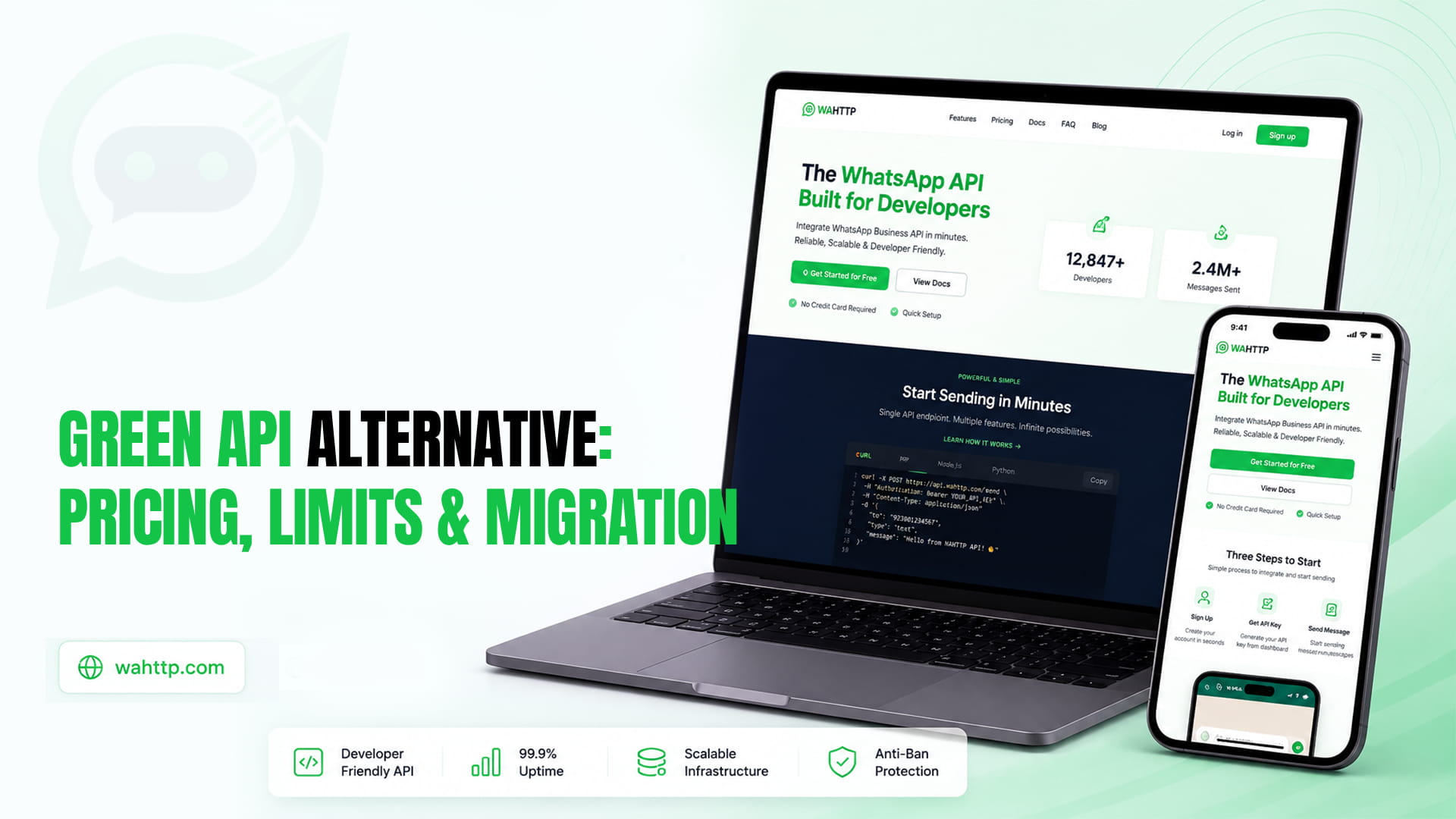
WaHttp, ours, so discount accordingly. $5 for one, $12 for three, $22 for six, $35 for ten, unlimited messages on every plan. Plain REST with no SDK by design, a Streamable HTTP MCP endpoint, server-side pacing and signed webhooks with delivery logs. We are in public beta, which is a fair thing to weigh against Green API's longer history.
Whapi.Cloud at $35 per channel. More expensive and still per-channel, but the only provider handling Channels, Communities and Status properly, so check your requirements before ruling it out on price.
WAHA, self-hosted under Apache-2.0 with all features in the free image since version 2026.6.1. No recurring fee, no currency exposure, no vendor. You run the server and absorb protocol changes. If your reason for using a free tier was that you have more time than budget, this is the honest continuation of that.
The broader picture, including the official Meta platform, is in our provider comparison.
What switching does not change
Every provider named above, us included, runs the same unofficial WhatsApp Web protocol, which breaches Meta's terms of service. Account restriction risk tracks how you send far more than who you send through. Moving from Green API to anyone else in this list does not improve your compliance position by a single degree, and any vendor implying otherwise is overselling. The Cloud API comparison covers what the sanctioned route actually costs.
You also keep your number, your chat history and your contacts. None of them live in Green API.
Migration
1. Measure your real usage first. Before choosing anything, pull a month of API call volume and message counts from Green API's console. Most people discover their traffic is either far below what they were about to pay for, or far above what a free tier would ever have sustained.
2. Audit your endpoints. Green API's methods like sendMessage and receiveNotification map onto conventional REST equivalents elsewhere. Most integrations touch four or five.
3. Note the polling difference. Green API's notification model is a queue you receive and delete from, which is a meaningfully different pattern to plain webhook delivery. If your code polls for notifications and acknowledges them, moving to a push-based webhook provider means restructuring that loop rather than renaming a function. Budget for it, because it is the single largest piece of work in this migration and the one people underestimate.
4. Build a webhook endpoint properly. Acknowledge with a 2xx fast, process in the background, verify the signature, and handle duplicates idempotently. If you were polling before, this is new code rather than adapted code.
5. Run in parallel on a spare number. A week of real traffic through the new provider before touching your production number.
6. Cut over during a quiet window. Unlink from Green API, scan the QR on the new platform, confirm connection.
7. Warm up gently. Re-authentication leaves a session in a more fragile state for a week or two. Resume at reduced volume rather than full throughput.
8. Keep the old instance for a fortnight. At these prices, a rollback window costs less than a bad afternoon.
Our feature list covers what webhook signing and delivery logs look like on our side if you want to compare against what you have now.
Common Questions
How much does Green API cost? There is a free Developer plan with limitations, a Business plan at 690 rubles a month with unlimited messaging, and a Partner plan from 23 rubles a day. Each plan covers one instance, meaning one WhatsApp number, and additional numbers are billed separately.
Is Green API's free plan good enough for production? Green API positions Developer as suitable for testing and MVPs rather than production. For customer-facing systems, the risk is that hitting a quota causes silent non-delivery rather than a graceful degradation.
What is the best Green API alternative? WasenderAPI and WaHttp for dollar-denominated bundled pricing across several numbers. Whapi.Cloud if you need Channels or Communities. WAHA if you would rather self-host and pay nothing recurring.
Does Green API support multiple WhatsApp numbers? Yes, but each number needs its own instance and is billed separately. There is no multi-number bundle, so costs scale linearly.
How hard is it to migrate off Green API? Endpoint mapping is straightforward. The real work is moving from Green API's receive-and-delete notification queue to push-based webhooks, which restructures your inbound handling rather than just renaming calls.
Will I lose my chat history? No. History, contacts and the number itself live on WhatsApp and your phone. You re-scan a QR code to link the number elsewhere.
Is a paid provider more reliable than a free tier? Usually, though not because of the price itself. Paid plans remove quota-based failure modes and typically come with support. Test the failure paths on any provider before committing: kill the session, take your endpoint offline, and watch what happens.