Gupshup has been named WhatsApp's Partner of the Year for both 2023 and 2024, and reviewers consistently rate its infrastructure as enterprise-grade and reliable. That is a real, earned reputation, built by supporting SMS, WhatsApp, RCS, Email, Instagram and voice calling under one platform with genuinely advanced features: WhatsApp Flows, catalogs, carousel messages, beta group messaging.
That same breadth is exactly what makes Gupshup the wrong tool for a large number of people who search for an alternative to it. If your actual requirement is "send and receive WhatsApp messages," you are evaluating a platform built to do six other things well too, and the cost of that breadth shows up before you send a single message.
The onboarding tax
User reviews describe Gupshup's setup process consistently: Facebook Business Manager verification, a WhatsApp Business API application that can take days to weeks, phone number approval, webhook integration that requires developer resources, conversation flow building, and sandbox testing before going live. One direct comparison puts realistic setup time at 24 to 48 hours of technical work, against roughly 30 minutes for a WhatsApp-only competitor with guided onboarding.
The platform itself gets mixed marks on top of that timeline. Reviewers describe the onboarding process as hard to navigate without clear categories, note that "creating apps process could have been simpler," and flag that the dashboard becomes complex and sluggish once you are managing more than a few parallel flows. One reviewer's summary was blunt: it works fine, but "for anything bigger, it starts to feel too basic," while another found configuring advanced chatbot flows genuinely complex. A recurring theme across independent review aggregations is dependency: businesses report needing ongoing developer involvement just to operate the platform day to day, rather than being able to hand it to non-technical staff once it is configured.
None of this is unusual for an enterprise CPaaS platform, where SMS routing, RCS fallback logic and multi-channel orchestration genuinely need that complexity. It is unusual, and unwelcome, if WhatsApp is the only channel you will ever touch.
The pricing opacity
This is the complaint that shows up most consistently across independent review sites. Gupshup's pricing is not published. G2 and Capterra both list it as "no pricing available," there is no free trial, and multiple review aggregations describe budget forecasting as "nearly impossible" without going through a sales conversation. One direct reviewer quote: "Gupshup 30% more costly than competitors," given as their explicit reason for choosing something else. Others describe the pricing as "a bit expensive," and note that per-message rates in the roughly $0.03 to $0.07 range make ordinary customer support conversations expensive at any real volume.
To be fair, Gupshup's own public rate card, where visible, is genuinely competitive in Indian and Southeast Asian markets, with markups as low as $0.001 to $0.004 per message on top of Meta's own fee. The complaint is less about the number and more about not knowing the number until you have already gone through discovery calls and negotiation, which is a real cost in time even when the eventual rate turns out fine.
The pattern in what users actually say
Pull the review quotes together and a consistent picture emerges, independent of any single source. "More focus on SMS marketing then WhatsApp Marketing." "Less featured related to WhatsApp API." "Designed for developers and enterprises, not for small businesses that just need WhatsApp up and running." "Gupshup's broad platform is powerful but complex for businesses wanting simple WhatsApp messaging."
That last line is the whole argument in one sentence, and it did not come from a competitor's marketing copy. It came from an independent comparison written by people evaluating the platform on its own merits.
What Gupshup is actually right for
Said plainly, because the pattern above is about fit, not quality: if you need SMS and WhatsApp and RCS working together with shared logic and fallback routing, if you are operating at genuine enterprise scale where a dedicated Customer Success Manager and negotiated volume pricing make sense, or if you specifically need WhatsApp's newest beta features like voice calling or group messaging as they roll out, Gupshup's breadth and its Partner of the Year track record are real advantages that a WhatsApp-only competitor cannot match. The complexity reviewers describe is largely the complexity of the problem it is built to solve. If that is your problem, this article's argument does not apply to you.
Simpler, if you need official Meta compliance
If what you actually want is the official Cloud API, the verified badge, templates and an audit trail, without the multi-channel platform wrapped around it, a WhatsApp-focused BSP gets you there with a fraction of the setup.
360dialog publishes its pricing outright: €49 to €249 a month flat, no markup on Meta's own message fees at all. No sales call required to learn the number, no bundled SMS or RCS infrastructure you will never touch, and onboarding is scoped specifically to WhatsApp rather than a general messaging platform. Our pricing breakdown has the full country-by-country rate card if you want to model this against Gupshup's per-message range directly.
Twilio is the equivalent choice if your team already runs SMS or voice through Twilio for other reasons, since it consolidates billing without adding Gupshup's broader feature surface.
Simpler if you do not need Meta approval at all
If your traffic is internal, conversational, or does not need the verified badge, a session-based API removes the entire onboarding timeline Gupshup requires, not just shortens it.
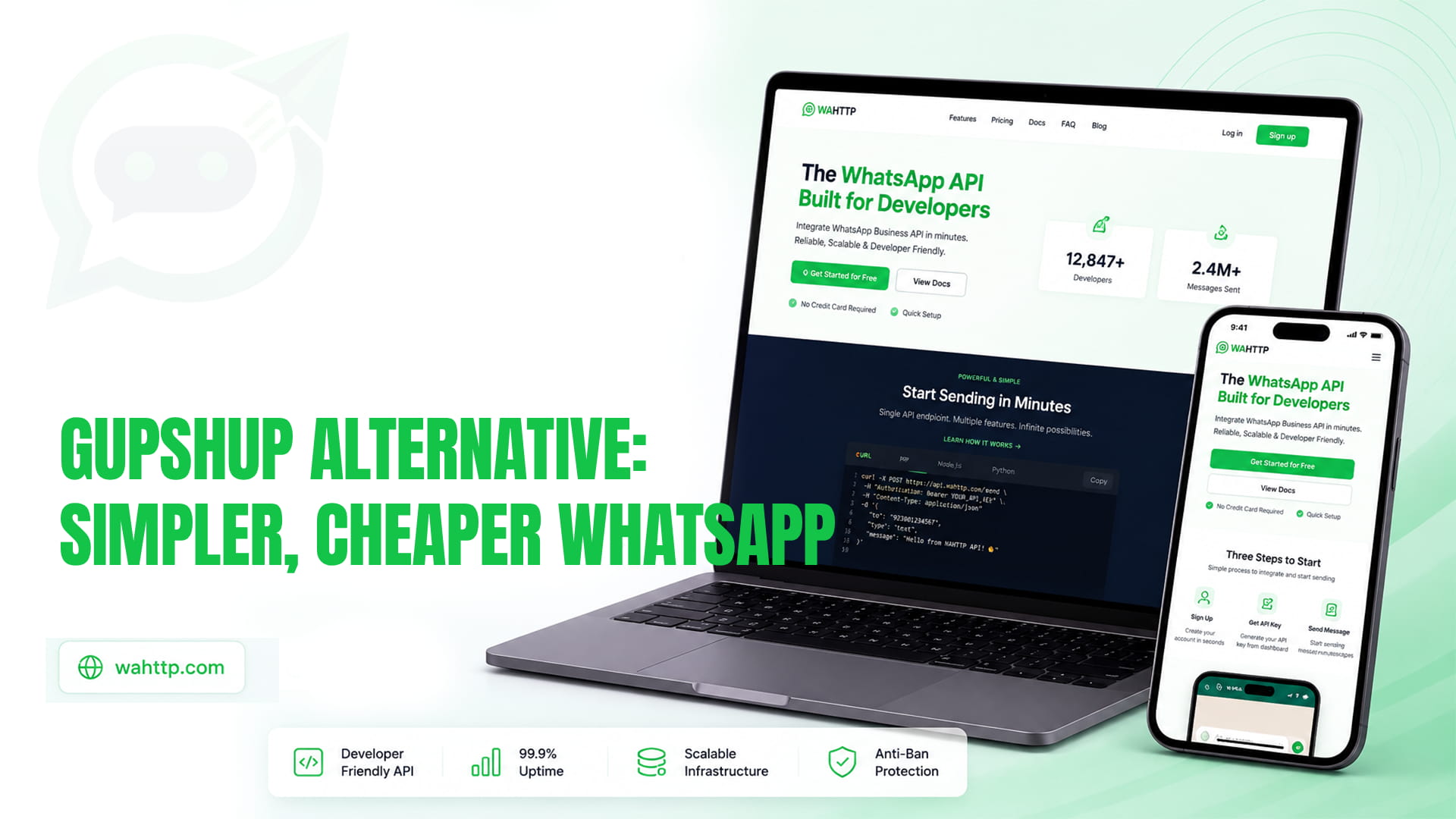
WaHttp, ours, so weigh accordingly. $5 to $35 a month for one to ten sessions, unlimited messages, published pricing with nothing to negotiate, and a working connection in minutes rather than the days to weeks a WABA application and phone number approval take. No dashboard complexity to grow into, because the whole product is REST endpoints and webhooks rather than a flow builder managing dozens of parallel automations. Full webhook access from the first plan, which is one of the specific setup steps reviewers flag as needing developer resources on Gupshup.
WasenderAPI sits at a similar price point with official SDKs for Node, Python and Laravel, if you would rather install a typed client than write raw HTTP calls.
The trade-off is real: you give up the verified badge, Meta's compliance backing and any multi-channel capability entirely. For traffic that never needed those things, that is not much of a trade at all.
Side by side
| Gupshup360dialogWaHttp | |||
| Channels | SMS, WhatsApp, RCS, Email, Instagram, Voice | WhatsApp only | WhatsApp only |
| Published pricing | No, sales-negotiated | Yes, flat | Yes, flat |
| Free trial | No | Varies | Yes |
| Typical setup time | 24–48 hours technical work, plus days–weeks for WABA approval | Hours once verified | Minutes |
| Meta approval required | Yes | Yes | No |
| Ongoing developer dependency | Reported as high | Low to moderate | Low |
| Best fit | True multi-channel enterprise messaging | WhatsApp-only, official, transparent | WhatsApp-only, no approval, fastest start |
Choosing correctly
Ask one question first: will you ever need SMS, RCS or another channel unified with WhatsApp under one platform, with shared automation logic across them? If yes, Gupshup's complexity is the cost of a real capability, and a WhatsApp-only alternative will eventually force you to bolt on a second platform for the rest, which is a worse outcome than starting with the right tool.
If the honest answer is no, you are paying Gupshup's onboarding timeline and absorbing its pricing opacity for channels you will never use. The full landscape of official and unofficial WhatsApp-only options, including where each one sits on price and compliance, is in our provider comparison.
Migration notes
Moving off Gupshup means separating what is genuinely WhatsApp-specific from what lives in Gupshup's broader platform. Your send and webhook logic maps onto any WhatsApp-focused competitor's endpoints in a straightforward way, a recipient, a message type, a body, an inbound event. What does not port is anything built inside Gupshup's cross-channel automation or bot flows, since that logic is specific to their platform and has no equivalent to export, so budget real time to rebuild that piece in code rather than assuming it transfers.
If you are keeping SMS or another channel on Gupshup while moving WhatsApp specifically to a dedicated provider, that split is common and usually cleaner than it sounds: the channels do not need to share a platform just because they once did, and running WhatsApp on a tool built only for WhatsApp tends to remove most of the friction reviewers describe.
Common Questions asked by Users
Is Gupshup good for WhatsApp specifically, or just multi-channel messaging generally? Reviewers consistently describe it as stronger and more feature-complete for SMS and general multi-channel orchestration than for WhatsApp specifically, with several noting the WhatsApp feature set feels secondary to the platform's broader focus.
Why is Gupshup's pricing not published? Gupshup uses a sales-negotiated pricing model rather than a public rate card, which independent reviews describe as making budget forecasting difficult before you engage with their sales process. Rates do vary by volume and country once negotiated.
How long does Gupshup onboarding actually take? Technical setup alone is commonly cited at 24 to 48 hours, and the underlying WhatsApp Business API application through Meta can add days to weeks on top of that, since Gupshup does not control Meta's own approval timeline.
What is the simplest Gupshup alternative for WhatsApp only? 360dialog if you need to stay on the official Cloud API, with transparent flat pricing and no bundled multi-channel platform. WaHttp or WasenderAPI if you do not need Meta approval and want the fastest possible setup with published, predictable pricing.
Is Gupshup more expensive than its competitors? Independent reviewers report this as a common complaint, with one directly citing a 30 percent higher cost than alternatives as their reason for switching. Gupshup's own published rate ranges in some markets are competitive; the complaint is as much about pricing opacity during evaluation as the eventual number.
Do I need developer resources to run Gupshup? Reviews describe an ongoing dependency on technical staff for configuration, webhook integration and flow management, more than some WhatsApp-only competitors require after initial setup. If your team lacks dedicated engineering support, this is worth weighing directly against a simpler platform.
Should I switch away from Gupshup if I use its multi-channel features? Generally no. The complexity and pricing model reviewers describe are largely inherent to supporting SMS, RCS, Email and WhatsApp together at enterprise scale, and a WhatsApp-only alternative will not replace that capability. The case for switching is strongest when WhatsApp is the only channel you actually use.