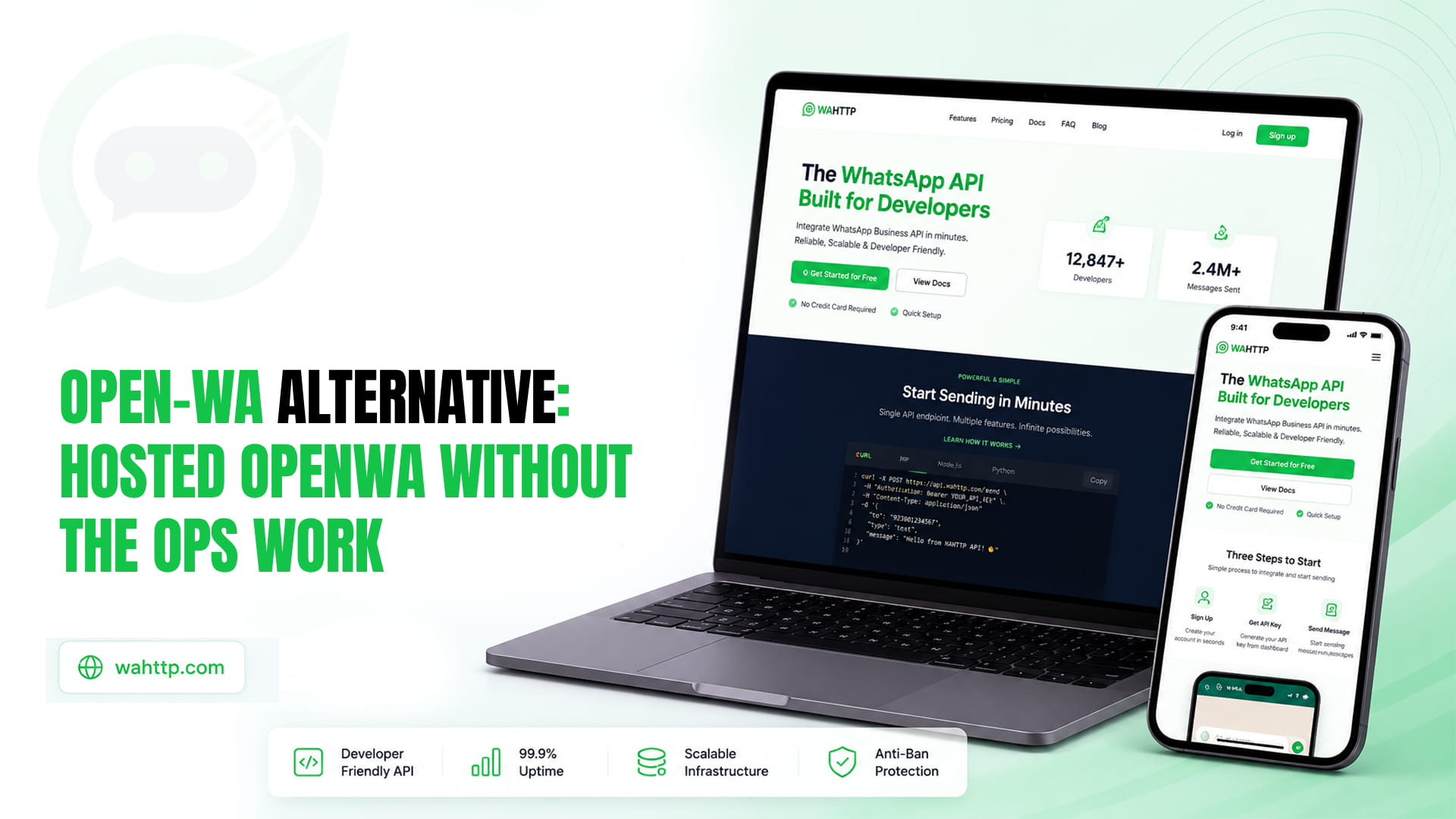
Open-wa shows up in searches attached to two different projects, and sorting out which one you're actually looking at matters before you evaluate either.
wa-automate-nodejs, under the open-wa GitHub organization, is the original and more feature-dense of the two: a modular v5 toolkit with a ready-made "Easy API" HTTP layer, an SDK for embedding the client directly, a plugin system with integrations for Chatwoot, Node-RED and Cloudflare proxying, and its own MCP server for connecting AI agents. Separately, a project called OpenWA at open-wa.org, maintained independently, offers a simpler self-hosted gateway with a dashboard and a choice between whatsapp-web.js and Baileys as the underlying engine, released under a plain MIT license. If you found this searching for "openwa," confirm which of the two you actually landed on, because their licensing terms are not the same.
Whichever one you mean, the pattern holds: both are things you deploy and run, not services you call.
What the original open-wa actually gives you
wa-automate-nodejs is genuinely more capable than most projects in this category. Its Easy API wraps the core client in interactive HTTP documentation out of the box, which is further along than Baileys or whatsmeow offer by default. The plugin SDK and native MCP server integration are a real differentiator, since AI-agent connectivity is something most WhatsApp libraries bolt on as an afterthought, if at all, and open-wa built it in directly. Browser driver flexibility is another genuine advantage: you can run it on Puppeteer, Playwright, or the lighter Lightpanda engine, which gives you a path to lower resource overhead than a fixed Puppeteer dependency locks you into.
The licensing detail worth reading before you commit
wa-automate-nodejs is released under the Hippocratic License with a Do Not Harm addendum, an ethical-source license rather than an OSI-approved open-source license like MIT or Apache. That distinction matters practically, not just philosophically: a number of corporate legal and procurement teams flatly reject non-OSI licenses regardless of how permissive the terms otherwise read, specifically because ethical-use clauses are largely untested in court and create ambiguity about enforcement. If your company requires OSI-approved licensing for anything that ships in production, this is a conversation to have with whoever handles that review before you build on it, not after. The separate open-wa.org project sidesteps this entirely with a standard MIT license, which is one more reason the naming confusion between the two is worth resolving early.
On top of the license question, wa-automate-nodejs's own documentation references optional license keys tied to enhanced features through its Easy API, alongside the open npm package. The core project is genuinely open source, but "enhanced features behind a key" is a real detail to confirm against your specific use case rather than assume away.
The part that doesn't change regardless of which project you pick
Either project is self-hosted software, and that comes with the same category of ongoing work every self-hosted WhatsApp toolkit asks for: provisioning a server or container, keeping it patched, monitoring session health, and reacting when WhatsApp's protocol shifts underneath you. wa-automate-nodejs v5 requires Node 22.21.1 or newer and pnpm specifically, which is a more current and more particular toolchain requirement than some teams will have standing by already. With 174 open issues on the main repository at the time of writing, community support is active but not the same thing as a vendor SLA when something breaks during a release window.
If you're running the Puppeteer or Playwright driver rather than Lightpanda, you're also back to the familiar resource math every browser-automation library carries: a real Chromium instance per connected session, generally 150MB or more at idle, which shapes how many numbers you can realistically run per server.
Same ban risk as the rest of the category
Both projects connect to WhatsApp as a linked device through its web protocol, not through Meta's official Business Platform, so the same terms-of-service exposure applies regardless of which engine or license you're running underneath. That risk is governed by sending behavior and volume more than by the specific tool, and it's worth weighing honestly against whatever workload you're planning to run on it.
Where open-wa is genuinely the strongest pick
If you want a self-hosted WhatsApp integration with a built-in MCP server for AI agents, a plugin ecosystem that already covers Chatwoot and Node-RED, and the flexibility to swap browser engines as your resource needs change, wa-automate-nodejs is one of the most complete open-source options available, licensing considerations aside. Our guide to connecting Claude to WhatsApp over MCP covers what that integration pattern looks like in practice, whether you build it on open-wa's own MCP server or a hosted equivalent. For teams that specifically need full infrastructure control and are comfortable with the Hippocratic License's terms, this is a reasonable and well-built foundation.
If you want the capability without running the stack
If what actually drew you here was "connect WhatsApp to my app or my AI agent," not "run a Node 22 toolchain with pnpm and a Chromium fleet," a hosted API gets you there without any of the licensing or ops questions above.
WaHttp connects by QR code the same way open-wa does, and gives you REST endpoints and webhooks from the first plan, plus its own MCP server at a stable endpoint if an AI agent is the actual integration you're building toward. $5 a month for one session with unlimited messages, up to $35 for ten, under standard commercial terms with nothing to clear with legal first. Our self-hosted WhatsApp API guide is worth reading either way, since it lays out the Docker, session-persistence and scaling considerations that apply across this whole category if self-hosting is still the right call for your situation. And because the default engine under most of these tools, open-wa included, is whatsapp-web.js, our whatsapp-web.js alternative post covers the Puppeteer-specific trade-offs in more depth.
Side by side
| wa-automate-nodejs (open-wa)OpenWA (open-wa.org)WaHttp | |||
| License | Hippocratic + Do Not Harm | MIT | Proprietary, hosted |
| Deployment | Self-hosted, Node 22+/pnpm | Self-hosted, Docker | Hosted |
| MCP server | Built in | Not native | Built in |
| Browser engines | Puppeteer, Playwright, Lightpanda | whatsapp-web.js or Baileys | Not applicable |
| Plugin ecosystem | Chatwoot, Node-RED, Cloudflare proxy | Pluggable storage/cache/DB | REST and webhooks |
| Ops required | Yes, full infrastructure | Yes, full infrastructure | None |
| Best fit | Teams wanting a full-featured self-hosted toolkit | Teams wanting a simpler MIT-licensed self-hosted gateway | Anyone who doesn't want to run infrastructure |
Choosing correctly
If full infrastructure control and the specific plugin or MCP capabilities matter enough to justify running and patching the stack yourself, confirm which project you mean, read the license that applies to the one you pick, and budget real ops time either way. If the actual goal was a working WhatsApp integration without owning a server, a hosted provider gets you the same connectivity, including MCP access if that's the point, without the toolchain, the Chromium fleet, or the licensing review.
Migration notes
Open-wa's event handlers and send methods map onto webhook events and REST calls in a straightforward way, recipient, message type, body, delivery status, the same shape every session-based platform shares. Anything built against open-wa's plugin SDK or its specific Node-RED and Chatwoot integrations will need to be rebuilt against whatever integration surface your new platform exposes, since those connectors are specific to this project and don't carry over as-is.