Respond.io built something genuinely good at what it's for: a single inbox across WhatsApp, Instagram, Messenger, Telegram, LINE and TikTok, with CRM sync, AI agents, and workflow automation layered on top, aimed at support and sales teams who live in a conversation window rather than a codebase. One G2 reviewer summed up exactly who that's for, calling it easy to use because it "doesn't complicate you with technical things or API conditions." That's a fair and accurate compliment, and it's also the clearest signal in this whole research pass that the product isn't built around the API as the primary interface.
If your actual plan is to build API-driven workflows, that same design choice becomes friction rather than simplicity.
Where the API sits in the plan structure
Respond.io runs four tiers billed by Monthly Active Contacts (MAC) rather than messages or seats: Starter at $79/month, Growth at $159/month, Advanced at $279/month, and a custom Enterprise tier, each priced against a baseline of 1,000 MAC with the slider climbing from there. MAC billing counts any contact you exchange messages with during the billing month regardless of volume, so a single customer sending forty messages in one support thread costs the same as one who sends two. That's a genuinely reasonable model for conversational support traffic, and it compares well against pure per-message pricing when conversations run long.
It's a different story for anyone evaluating this as an API platform specifically. Developer API access requires the Growth tier or higher, $159 a month minimum before you can call it at all. Outbound webhooks, the mechanism most real integrations actually depend on to react to events in near real time, are restricted to the Advanced tier and above, $279 a month minimum. There's no sandbox environment to build and test against before you're paying for production access either. If you're prototyping an integration, the entry point isn't a free tier or a developer plan, it's a $159 to $279 monthly commitment before you've confirmed the integration does what you need.
What the API actually supports once you're in
To be fair, once you clear that tier threshold, the API surface itself is broad: template and session messages, media, interactive buttons, product and catalog messages, WhatsApp Flows sync, inbound and outbound webhooks, broadcast messaging, contact and conversation management, and CRM integration. Respond.io has also built genuinely modern developer tooling around it, an MCP server exposing roughly 28 tools, published llms.txt documentation, and a TypeScript/JavaScript SDK, which puts real effort behind making the platform usable by AI agents and not just human developers. Independent evaluation of the documentation itself scored it low for clarity, and setup speed as middling, which tracks with a product whose primary audience has historically been inbox users rather than integrators building against it directly.
WhatsApp and Meta's own messaging fees are never included in any respond.io plan and pass through without markup, which is worth noting as a point in its favor: you're not paying a hidden margin on top of Meta's rate card, only the platform fee for the tier you're on.
The pattern in what users actually say
Independent reviews are consistent on where the friction lives. Pricing is the most common complaint, described directly as expensive, with specific notes that costs feel steep for businesses in price-sensitive markets as contact volume grows. Workflow automation, the feature most relevant to anyone trying to build logic rather than just reply to chats, is flagged as having a real learning curve: "building more sophisticated workflows can take some time to understand," in one reviewer's words. And respond.io's own published FAQ on its common pros and cons is unusually candid that smaller businesses under roughly 500 conversations a month may find the entry pricing inefficient, and that the more advanced capabilities sit behind higher tiers, both of which line up with the API-access gating described above.
Where respond.io is genuinely the right tool
If your team is support or sales agents working conversations by hand across several channels at once, and you want AI assistance, CRM sync and workflow building without writing code, respond.io's breadth is a real and well-executed answer to that problem. The omnichannel inbox, the 24/7 support reviewers consistently praise, and the CRM integrations with tools like HubSpot and Salesforce are not things a raw API replaces, because they're not API problems. The reviewer who liked that it avoided "API conditions" was describing exactly the audience this product is built for, and for that audience, the tier structure is pricing a real product correctly rather than gatekeeping something that should be free.
If the API was always the point
If what you actually want is to build your own logic against WhatsApp, triggered by webhooks, running through your own backend or a tool like n8n, paying $159 to $279 a month to unlock that access on a platform built primarily for a shared inbox is solving the wrong problem. A provider priced around the API itself gets you there without the tier climb.
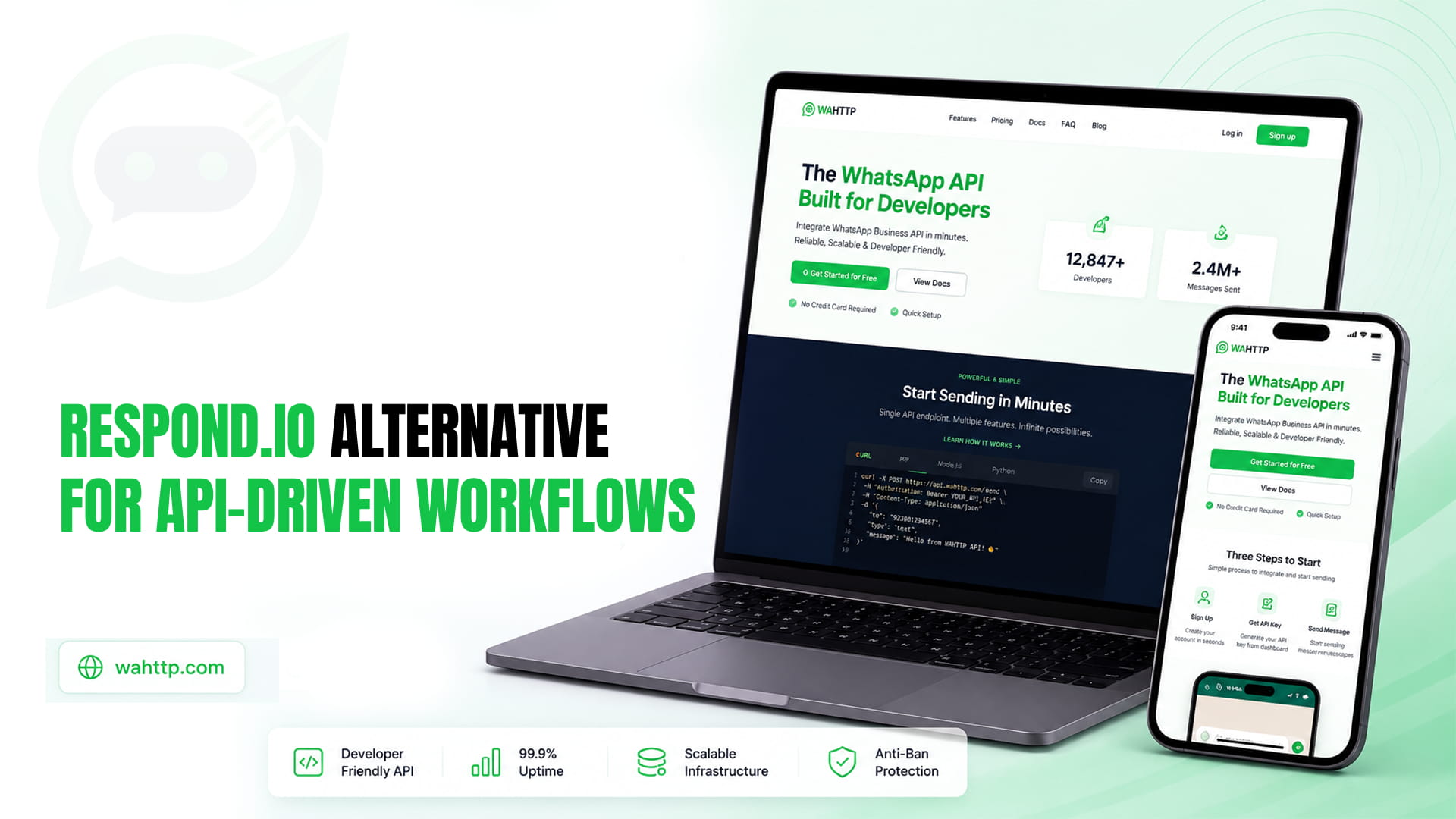
WaHttp gives you REST endpoints and webhook delivery from the first plan, no MAC billing to model, no feature gate between you and outbound events. $5 a month for one session with unlimited messages, up to $35 for ten. Our webhook integration guide covers exactly the piece respond.io holds back until Advanced, receiving and reacting to inbound events in real time, and it's available from the entry plan here rather than the top one.
If the workflow automation was the feature you actually wanted from respond.io, building that same logic yourself with a direct API and n8n is often more flexible and considerably cheaper than paying for a vendor's workflow builder, and our n8n WhatsApp automation guide shows what that setup looks like without a monthly platform fee layered on top. For the full landscape of where API-first and inbox-first platforms each fit, our provider comparison lays out the options side by side.
Side by side
| respond.io WaHttp | ||
| Primary interface | Shared inbox, AI agents, no-code workflows | REST API |
| API access | Growth tier and up ($159/mo+) | Included from first plan |
| Outbound webhooks | Advanced tier and up ($279/mo+) | Included from first plan |
| Sandbox environment | None | Free trial available |
| Billing model | Monthly Active Contacts | Flat per session |
| Omnichannel inbox (IG, Messenger, Telegram, etc.) | Yes | No, WhatsApp only |
| Best fit | Support/sales teams working conversations by hand | Developers building their own logic |
Choosing correctly
If your team needs humans and AI agents collaborating across several messaging channels in one shared view, respond.io's inbox-first design is the right tool, and the pricing is for that product, not a tax on the API. If the inbox was never the point and you just wanted programmatic access to WhatsApp without paying to unlock it, an API-first provider gets you to a working integration faster and without the tier climb.
Migration notes
Respond.io's webhook event shapes and its API's message-send calls map onto any direct WhatsApp provider's equivalents in a straightforward way, recipient, message type, body, delivery status. What doesn't move directly is anything built inside respond.io's workflow automation canvas or its CRM sync layer, since those are specific to its platform and have no API-level export; replicating that logic means rebuilding the automation in your own code or a tool like n8n, which is real engineering work but a bounded, well-understood kind.