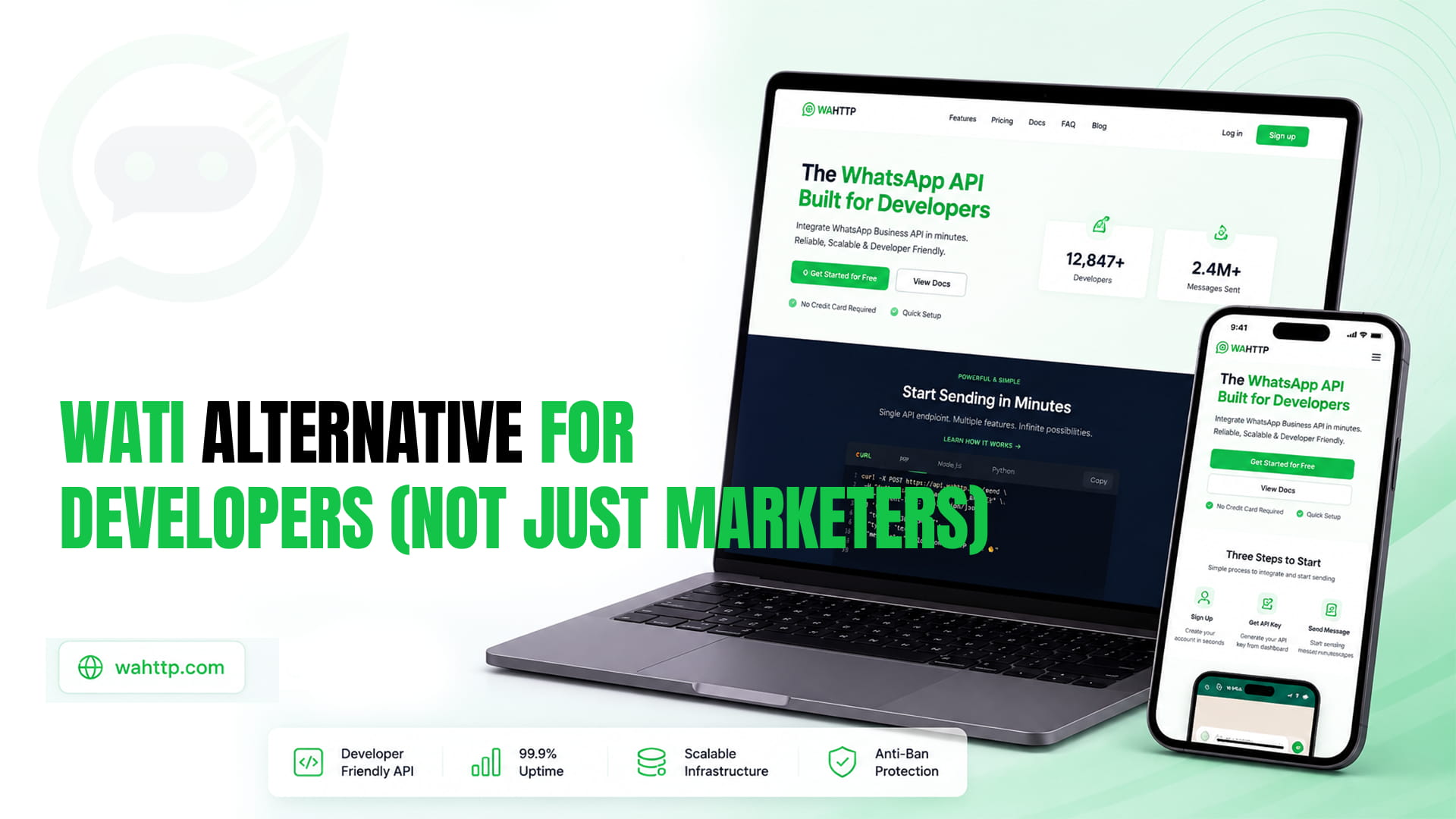
Wati reviews consistently describe the same buyer: an SMB marketing, sales or support team that wants a shared inbox, a no-code chatbot builder and broadcast campaigns, without hiring anyone to build it. That is an accurate description of a good product doing its job well.
It is also a description that tells you, before you read a single spec, who Wati was not built for. If you are a developer looking to build on top of a WhatsApp API rather than operate a team inbox, the signals that this is the wrong tool are visible in the pricing page itself, not hidden in the fine print.
The tell is in the API limits, not the marketing copy
Every WhatsApp API platform claims developer access. What separates a developer-first product from a team-inbox product with an API bolted on is what happens when you actually try to build something.
On Wati's entry-level Growth plan, API access is capped at roughly 10,000 calls a month, with no webhooks included at all. The Pro tier raises that to around 200,000 calls with what reviewers describe as limited webhook support. Full webhook access and higher throughput sit on the top Business tier, priced from roughly $199 to $349 a month depending on billing cycle and which review's pricing snapshot you trust, since Wati's own published numbers have moved across the year.
Sit with that for a second from a builder's perspective. Webhooks are not an advanced feature you graduate into. They are the basic mechanism by which you receive a message in real time, and on the plan most individual developers and small teams would actually sign up for, they are either absent or limited. An API call cap in the tens of thousands sounds generous until you remember that every status update, every read receipt and every inbound message event can count against it, and a support bot handling a few hundred conversations a day burns through that ceiling faster than the sticker price suggests.
Pricing by seat, not by what you build
Wati's plans include a fixed number of users, three on Growth, five on Pro and Business, with additional users billed separately at anywhere from $24 to $89 a month each depending on tier and which pricing snapshot you check. That is a sensible model for a support team where headcount is the natural unit of scale. It is a strange one for a developer, where the natural unit of scale is messages sent, numbers connected, or API calls made, none of which map cleanly onto "how many humans have a login."
If you are building a product that happens to send WhatsApp messages, rather than staffing a WhatsApp inbox, you are paying for seats nobody is using.
The real bill is bigger than the plan price
Wati passes Meta's per-message fees through on top of the subscription, which every official BSP does. What is specific to Wati is that the markup on those fees is not published, with independent reviews estimating it around 20 percent, and that automation triggers and AI Co-pilot credits beyond each plan's included allowance are sold as metered add-ons with no published rate. One detailed review put a realistic all-in cost for a mid-size team at roughly three to five times the advertised subscription price once message volume, overage and add-ons are counted.
For a marketing team running a fixed number of monthly campaigns, that is knowable and budgetable in advance. For a developer building a product where usage scales with your own customer base, an unpublished markup stacked on metered, unpriced add-ons is close to impossible to forecast, and forecasting your own cost of goods sold is exactly the thing you need to do before shipping.
What this comparison actually is
To be fair to Wati, because the criticism above is really a mismatch rather than a flaw: none of this makes Wati bad software. Reviews are consistently positive on the inbox, the no-code chatbot builder, the Shopify and HubSpot integrations, and the overall experience for the buyer it was built for. The product is doing exactly what a marketing and support platform should do. The complaint from a developer's seat is not that Wati executes its vision poorly, it is that the vision itself, team inbox first with an API as a supporting feature, is the wrong shape for someone who wants the API to be the product.
What developers should actually be comparing against
If you need to stay on Meta's official Cloud API but want raw access without the inbox layer. Twilio and 360dialog are built for exactly this. No seat pricing, no capped API call tiers, webhooks included from the start, and you pay Meta's message fees plus a transparent, published markup rather than an unpublished one. Twilio charges no base platform fee with roughly $0.005 added per message; 360dialog runs €49 to €249 a month flat with no markup on Meta's rate at all. Neither bundles a team inbox, which is precisely the point if you are building your own interface or none at all. Our pricing breakdown has the full rate card for modeling this properly.
If you do not need official Meta approval and want the fastest, cheapest path to a working integration. Session-based APIs remove the entire category of problem, because there is no seat model, no tiered API call cap and no metered add-on menu to forecast. WaHttp runs $5 to $35 a month for one to ten sessions with unlimited messages and full webhook access on every plan from day one, no tier to unlock it. WasenderAPI is similarly priced with official SDKs for Node, Python and Laravel. Neither requires Business Verification, a WABA, or template approval, which also means neither can offer the verified badge or click-to-WhatsApp ads Wati's official platform provides. Our comparison of the two categories covers that trade-off properly.
Side by side, for a developer specifically
| Wati GrowthWati BusinessTwilioWaHttp | ||||
| Base price | ~$39–59/mo | ~$199–349/mo | $0 platform fee | $5–35/mo |
| Included users | 3 | 5 | N/A, not seat-based | N/A, not seat-based |
| API call limit | ~10,000/mo | Higher, not published | None published | None |
| Webhooks | Not included | Included | Included | Included, all tiers |
| Message fee markup | Unpublished, ~20% est. | Unpublished, ~20% est. | $0.005/msg, published | None, flat pricing |
| Meta approval required | Yes | Yes | Yes | No |
| Team inbox / no-code chatbot | Included | Included | Not included | Not included |
| Built for | Marketing/support teams | Marketing/support teams | Developers | Developers |
When Wati is still the right answer
If you are the marketing or support team, not a developer building on top of one, this whole article is the wrong lens. A no-code chatbot builder, a shared inbox multiple agents can work from, and pre-built Shopify and HubSpot integrations are genuinely valuable, and building that yourself on a raw API is real engineering effort most teams should not take on. If that describes your actual need, Wati's pricing is buying assembled software, and the per-seat model is a sensible reflection of a team-shaped product.
The distinction that matters is not "Wati versus better," it is "team-inbox product versus developer platform," and most people searching for a Wati alternative already know, once they see the API limits, which side of that line they are actually on.
Migration notes for developers leaving Wati
If you have been using Wati's raw API rather than its inbox, the migration is smaller than it looks. Wati's send and webhook endpoints follow the same conceptual shape as any competitor: a recipient, a message type, a body, an event payload on receipt. What takes longer is untangling anything your team built inside Wati's no-code flows or chatbot builder, since that logic lives inside their platform and has no direct export. Budget real time for rebuilding that piece specifically in code, rather than assuming it ports.
If part of your team still needs the inbox and part needs raw API access, consider running both: keep Wati, or a comparable inbox platform, for the humans answering conversations, and build your product's own messaging on a developer-first API separately, following the same send and receive patterns regardless of which provider sits underneath. They do not have to be the same number, and separating them is often cleaner than forcing one platform to serve two different jobs.
Common Questions
Does Wati have API rate limits? Yes. Reported limits vary by plan, with the entry-level Growth tier capped around 10,000 API calls a month and no webhooks included, rising through higher tiers. Check current limits directly with Wati before committing, since published figures vary across sources and pricing snapshots.
Is Wati good for developers? It offers API access, but the product and its pricing are built around a team inbox and no-code automation rather than raw developer access. Lower tiers in particular are constrained in ways that matter more to a builder than to the marketing or support team the plans are priced for.
What is the best Wati alternative for building a product, not staffing an inbox? For staying on the official Cloud API, Twilio or 360dialog offer raw access with no seat pricing and no API call caps. For skipping Meta approval entirely, flat-rate session-based APIs like WaHttp or WasenderAPI include full webhook access from the first dollar spent.
Does Wati charge extra for webhooks? Effectively yes, in that webhook access is limited or absent on the entry-level plan and expands on higher tiers, based on third-party pricing analysis rather than a single published Wati policy, so verify current terms directly.
Is Wati's per-message markup published? Not explicitly on their pricing page as of current reviews; independent estimates put it around 20 percent on top of Meta's own rates. Compare that to BSPs like Twilio and 360dialog, which publish their markup or charge none at all.
Can I use Wati just for its API without paying for the inbox features? Not really. Wati's plans bundle the inbox, chatbot builder and API access together rather than offering a raw-API-only tier, so a developer who wants only API access is paying for seats and inbox tooling regardless of whether they use it.
Should a small startup use Wati or a developer-first API? Depends on who is doing the work. If non-technical staff will manage conversations day-to-day, Wati's inbox earns its price. If the product itself sends and receives the messages programmatically with no human inbox in the loop, a developer-first platform avoids paying for tooling that goes unused.