Whatsmeow shows up in a lot of searches it probably shouldn't, because most of the people looking for a "whatsmeow alternative" aren't unhappy with whatsmeow. They just discovered, partway through the README, that it is a Go library for talking to WhatsApp's multidevice protocol, not a service they can point an HTTP request at. If your team writes Python, Node, PHP or Ruby, that discovery is the whole reason you are reading this.
Whatsmeow deserves the respect it gets. It is maintained by Tulir Asokan, the engineer behind Beeper's WhatsApp bridge and the mautrix-whatsapp project, and it is the library actually running in production for a real cross-platform chat product with a meaningful user base. That is a stronger production pedigree than most WhatsApp libraries in any language can claim.
None of that changes what it is: a library you import into a Go binary, not an API you call.
What whatsmeow actually gives you
Whatsmeow implements the WhatsApp Web multidevice protocol directly: pairing by QR code or phone number, one-to-one and group messaging with media, group management, typing indicators, delivery and read receipts, newsletter and channel support, app-state sync, and Signal-protocol end-to-end encryption underneath all of it. It does this in pure Go, with no Node runtime and no headless browser required, which is a real architectural advantage over browser-based approaches. Goroutines handle concurrent sessions cheaply, and static compilation to a single binary makes deployment simpler than shipping a Node process with a node_modules folder.
It does not support voice or video calls, and broadcast lists are unsupported (WhatsApp Web itself doesn't have them either). Status messages are marked experimental. And the project is explicitly pre-1.0: breaking changes between versions are expected, not an edge case you might hit.
The catch: you are getting a library, not a service
This is the part that sends people searching for alternatives. Whatsmeow gives you Go functions to call. It does not give you:
An HTTP layer. There is no POST /messages endpoint. You write the Go code that receives an HTTP request, calls the whatsmeow client, and returns a response, or you don't get one at all.
A webhook delivery system. Whatsmeow surfaces incoming events to your Go event handler. Turning that into a webhook POST to your own backend, with retries and delivery guarantees, is your code to write.
Session persistence you don't manage yourself. Whatsmeow needs a SQLite or Postgres store for session state, and you are responsible for backing it up, migrating it, and recovering it if a container restarts mid-session.
Multi-tenant session management. Running one number is one client instance. Running fifty client numbers for fifty customers means you build the orchestration layer, the routing, and the per-tenant isolation yourself.
Any support beyond community channels. Help lives on GitHub Discussions and a Matrix room. That is genuinely responsive for a community project, but it is not a vendor SLA, and there is nobody to escalate to when something breaks in production at 2am.
None of this is a criticism of the library. It is doing exactly what a library is supposed to do: giving you correct, well-tested building blocks. The gap between "library" and "the thing I can actually deploy and call from my app" is real work, and it is work every whatsmeow user ends up doing, whether they realize it upfront or discover it three weeks into the project.
The Go requirement locks out most teams before any of that
Even setting the library-versus-API gap aside, whatsmeow requires Go. That is a hard requirement, not a preference, for a large share of the teams evaluating it. A product team running Node on the backend, a Python data team building an internal ops bot, a PHP shop with an existing WhatsApp-adjacent app, a no-code automation builder wiring up n8n or Make, none of them get to use whatsmeow's actual advantages without either learning Go or standing up a separate Go microservice just to talk to WhatsApp and exposing it internally as its own API, which puts you back at building the HTTP layer whatsmeow never gave you in the first place.
Pre-1.0 and proud of it
Whatsmeow's own documentation is upfront that breaking changes happen between releases, and the project has never claimed API stability as a goal ahead of a 1.0 that isn't scheduled. For a library embedded in a product you plan to run for years, that is a maintenance cost worth pricing in honestly: someone on your team needs to track releases and re-test after upgrades, indefinitely.
Ban risk is baked in, same as every session-based approach
Whatsmeow connects to WhatsApp the same way Baileys and whatsapp-web.js do: as a linked device on the multidevice protocol, not through Meta's official Business Platform. That means the same terms-of-service exposure applies. Community discussion around the library has specifically noted that even low-volume, reply-only, otherwise unremarkable usage has occasionally drawn ban notices, which lines up with what we've written about the entire session-based category: risk correlates with behavior and volume more than with which library sits underneath, but it is never zero. If compliance and a guaranteed channel matter more than flexibility, the official Cloud API is the honest answer, and we've laid out that trade-off in full in WhatsApp API without Meta approval.
Where whatsmeow is actually the right choice
To be fair to it directly: if your team already writes Go, if you are building something closer to a bridge or a platform than a simple integration, if you specifically need raw protocol-level access to build custom behavior no wrapper exposes, or if you are running at a scale where goroutine concurrency and a small static binary meaningfully beat a Node process's memory footprint, whatsmeow is a strong foundation and probably the best one available in Go. Beeper didn't pick it by accident. The rest of this article is for the much larger group of people who read "Go library" and immediately wanted something else.
If you want what whatsmeow gives you, without building it yourself
WAHA, if you want to self-host and still get whatsmeow's underlying protocol implementation. WAHA's GOWS engine wraps whatsmeow directly, and puts a REST API, a dashboard and Docker deployment on top of it, so you get the library's advantages without writing the HTTP layer, the webhook delivery, or the session store management by hand. This is the closest thing to "whatsmeow, but as an API" that exists, and it is worth trying first if self-hosting matters to you for cost or data-residency reasons.
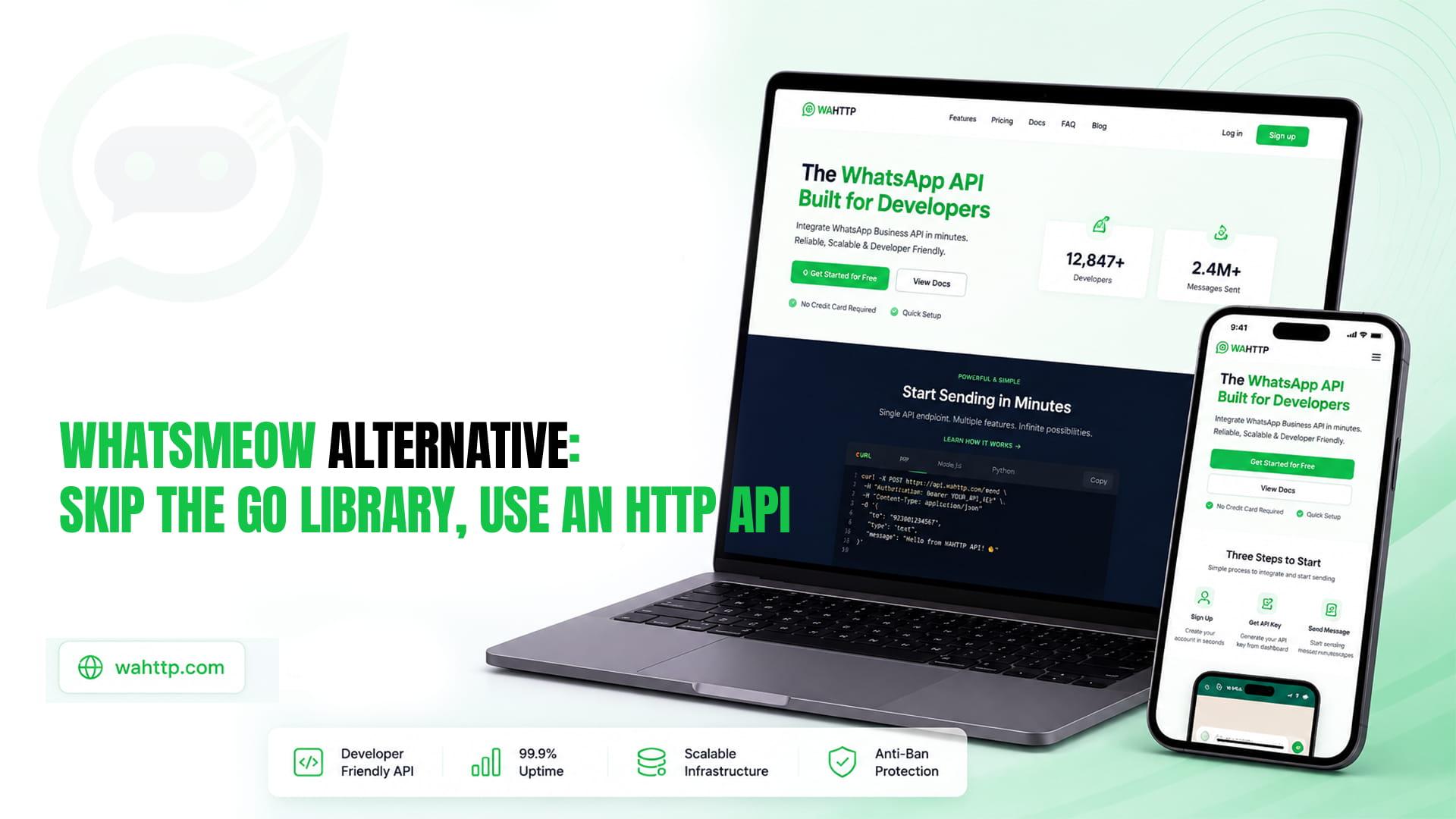
A hosted flat-rate HTTP API, if you would rather not run any infrastructure at all. WaHttp is built exactly for this: connect a number by QR code, call REST endpoints, receive webhooks, done. $5 a month for one session with unlimited messages, up to $35 for ten, no per-message billing and no Go, Docker or session-store maintenance on your side. If your actual requirement was "send and receive WhatsApp messages from my app," this removes the entire category of work whatsmeow leaves for you to do yourself, in whatever language your team already writes.
Side by side
| whatsmeow (raw)WAHA (GOWS engine)WaHttp | |||
| What you get | Go library | Self-hosted REST API wrapping whatsmeow | Hosted REST API |
| Language requirement | Go | Any (HTTP) | Any (HTTP) |
| You build the HTTP layer | Yes | No | No |
| You manage session storage | Yes | Yes, but abstracted | No |
| Infrastructure to run | Your own Go service | Docker container(s) | None |
| Support | Community (GitHub/Matrix) | Community, active project | Vendor support |
| Cost | Free, your engineering time | Free, self-hosting cost | $5–$35/month flat |
| Meta approval required | No | No | No |
Choosing correctly
If you are already comfortable running Docker containers and want full control with no per-message or per-session fee, WAHA's GOWS engine gives you whatsmeow's protocol implementation with the operational layer already built, which is the more thorough answer to "self-hosted WhatsApp API" than raw whatsmeow will ever be. Our self-hosted WhatsApp API guide covers exactly this kind of setup, including the session persistence and protocol-drift trade-offs that apply whether you're on Baileys, whatsapp-web.js or whatsmeow underneath.
If you don't want to run infrastructure at all, and would rather have a working webhook and REST endpoint in minutes instead of a Go service to maintain indefinitely, a hosted flat-rate provider is the faster and cheaper path for almost every team that isn't Beeper.
Migration notes
If you've already started building on raw whatsmeow, the concepts port cleanly even though none of the code does. Your event handlers become webhook consumers. Your outbound function calls become HTTP requests. Session pairing by QR code works the same way on every session-based platform, since it's the same underlying WhatsApp protocol feature everywhere. What doesn't port is any custom protocol-level logic you built directly against whatsmeow's Go types, if you went deep enough to touch those; that layer is Go-specific by definition, and moving to any HTTP-based wrapper means giving it up in exchange for not having to maintain it.
Common Questions
Is whatsmeow an API? No. It's a Go library you import into your own application. There's no hosted endpoint to call and no REST layer included; you either write one yourself or use a wrapper like WAHA that provides one.
Can I use whatsmeow without knowing Go? Not directly. The library only exposes a Go interface. Teams without Go expertise typically either learn enough Go to build a thin service around it, or use a project like WAHA that already wraps it in a language-agnostic REST API.
Is whatsmeow better than Baileys? They solve the same problem in different languages with different trade-offs. Whatsmeow's native binary and goroutine concurrency generally use less memory at scale than Baileys' Node.js runtime, and whatsmeow has strong production credibility through Beeper. Baileys has a larger community and a bigger ecosystem of wrappers and tutorials since JavaScript is more widely used for this kind of integration. Our full Baileys alternative comparison covers this in more depth.
Will using whatsmeow get my number banned? The risk is the same as any session-based approach, because whatsmeow connects the same way Baileys and whatsapp-web.js do, as a linked device outside Meta's official platform. Community reports include bans even on low-volume, reply-only usage, so treat any session-based library, whatsmeow included, as carrying real and unpredictable risk.
What's the easiest way to get an HTTP API on top of whatsmeow? WAHA's GOWS engine is the most direct route if you want to self-host. If you'd rather not run infrastructure at all, a hosted provider like WaHttp gives you the same category of session-based messaging without whatsmeow, Go or Docker anywhere in your stack.
Does whatsmeow support voice calls or broadcast lists? No. Both are explicitly unsupported. Broadcast lists aren't available in WhatsApp Web either, so that gap exists across the whole session-based category, not just whatsmeow.
Is whatsmeow actively maintained? Yes, and more actively than most libraries in this space, in part because it underpins Beeper's production WhatsApp bridge. It is still pre-1.0, though, so expect breaking changes between versions rather than a stable long-term API contract.