WPPConnect is the most complete of the open-source WhatsApp automation projects in one specific sense: it doesn't stop at a library. wppconnect-server wraps the core library in a token-authenticated, Swagger-documented REST API with multi-session management built in, which is exactly the layer that Baileys, whatsmeow and Venom all leave for you to build yourself. If you've read our posts on any of those, you'll recognize "you have to build the HTTP layer" as the recurring complaint. WPPConnect is the project that actually addressed it.
That makes it genuinely well regarded, particularly among agencies running many client numbers at once, where a ready multi-session REST API with webhooks saves real engineering time. It's also why "WPPConnect alternative" is still a common search: shipping a server is not the same as hosting one, and the gap between those two things is where most of the ongoing cost lives.
What you're actually getting
The WPPConnect ecosystem has three pieces. The core library drives WhatsApp Web through Puppeteer and Chromium, the same browser-automation approach as Venom and whatsapp-web.js. wppconnect-server sits on top of it as an Express-based REST layer with token auth, session endpoints, webhook delivery and Swagger documentation, built with Docker deployment in mind and able to integrate with MongoDB and Redis for session and queue storage. wa-js is a separate browser-side layer used inside extensions and injected scripts. Together, this is a more complete offering out of the box than any other open-source project in the category, and it shows: the library has around 3.4k stars, the server around 1,000, and the most recent release at the time of writing landed in May 2026, which is noticeably more active than some of its peers.
The part nobody's server ships for free: running it
A REST API you deploy yourself is still a server you're responsible for. wppconnect-server's own documentation walks through Docker Compose setup with MongoDB and Redis as supporting services, which means your task list includes provisioning that infrastructure, keeping the containers patched, monitoring uptime, and handling what happens when a session drops overnight and nobody's watching the logs. None of this is unusual for self-hosted software. It is real, ongoing operational work that a hosted API removes entirely, and it's worth being honest that "REST API included" and "nothing to maintain" are different claims.
Because the underlying engine is Puppeteer, the resource math is the same as Venom or whatsapp-web.js: each connected session is a real headless Chromium instance, generally 150 to 300MB of memory at idle. Running a handful of client numbers is manageable on modest hardware. Running dozens means sizing a server around Chromium's footprint, not around the REST layer sitting on top of it, and that's before accounting for MongoDB and Redis running alongside it.
Protocol drift is the other ongoing cost. WhatsApp changes its web client without notice, and when it does, the Puppeteer automation underneath WPPConnect can break until the maintainers patch it. The May 2026 release cadence suggests the team is keeping up, but "keeping up" still means you're on the hook for updating your deployment promptly when a fix lands, not a moment later.
The license is worth reading before you bundle it
WPPConnect is licensed LGPL-3.0-or-later, which stands out in a category where Baileys, whatsapp-web.js and whatsmeow all use permissive licenses (Apache 2.0 or MIT-style terms). LGPL is generally fine for calling the library over a network boundary or running the server as-is, but it carries copyleft obligations if you modify and redistribute the library itself as part of a closed-source product. If you're planning to embed WPPConnect's code directly inside something you'll ship to customers rather than run as a standalone service, get that read by whoever handles license compliance before you commit engineering time to the integration.
Same ban risk as every session-based approach
WPPConnect connects as a linked device through WhatsApp Web automation, not through Meta's official Business Platform, so the same terms-of-service exposure applies here as it does to every other project in this category. Nothing about having a nicer REST layer on top changes how WhatsApp's enforcement systems evaluate your account; that's governed by sending behavior and volume, not by which open-source project sits underneath.
Where WPPConnect is genuinely the right call
If you're an agency running many client WhatsApp numbers and you want to self-host with full control over data and infrastructure, WPPConnect's built-in multi-session REST API and webhook support are a real head start that no other open-source project in this space matches out of the box. If you already run Docker, Mongo and Redis in production and have someone on staff who owns that stack, the operational cost described above is marginal, not new. The project has earned its "agency favorite" reputation honestly, and if data residency or full infrastructure control is a hard requirement, this is one of the strongest self-hosted starting points available.
Same power, without the server
If what actually drew you to WPPConnect was the REST API and multi-session support, not a specific need to run your own Docker stack, a hosted flat-rate provider gets you the same category of capability with none of the deployment.
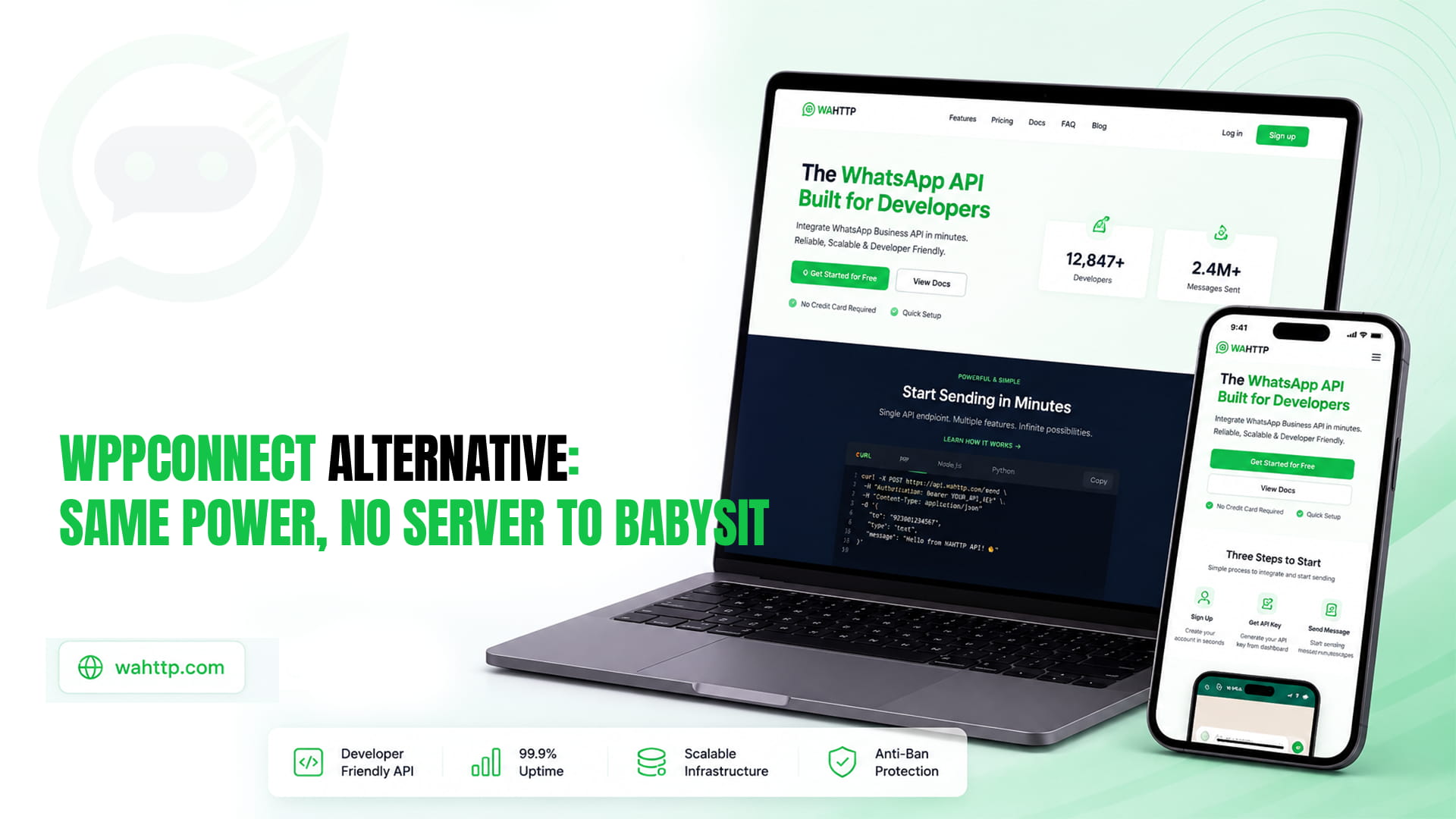
WaHttp connects a number by QR code the same way WPPConnect does, and gives you REST endpoints and webhook delivery from the first plan, no MongoDB, no Redis, no Chromium instances to size a server around. $5 a month for one session with unlimited messages, up to $35 for ten. Our webhook integration guide covers the receiving side in detail, and it's the same shape of integration WPPConnect's webhook feature gives you, minus the server you'd otherwise be running to deliver it.
If self-hosting is a firm requirement, our self-hosted WhatsApp API guide walks through what the Docker Compose setup, session persistence, and scaling planning actually involve across this whole category, so you can weigh WPPConnect's specific infrastructure needs against the alternatives with real numbers rather than a features list. And since WPPConnect shares its Puppeteer-based architecture with whatsapp-web.js, our whatsapp-web.js alternative post goes deeper on the memory and scaling trade-offs that come with any browser-automation approach.
Side by side
| WPPConnectBaileys / whatsmeowWaHttp | |||
| Architecture | Puppeteer/Chromium + REST server | Direct WebSocket protocol | Direct WebSocket protocol |
| REST API included | Yes, wppconnect-server | No, build your own | Yes, hosted |
| Deployment | Docker, MongoDB, Redis, self-managed | Self-hosted, your own HTTP layer | None |
| Memory per session | ~150–300MB+ | ~20–50MB typical | Not your infrastructure |
| License | LGPL-3.0-or-later | Apache/MIT-style | Proprietary, hosted service |
| Best fit | Agencies self-hosting multi-session | Teams wanting full protocol control | Anyone who wants no infrastructure |
| Cost | Free, your infrastructure | Free, your infrastructure | $5–$35/month flat |
| Meta approval required | No | No | No |
Choosing correctly
If running your own infrastructure is the point, because of data residency, cost at very high session counts, or wanting to modify the stack directly, WPPConnect is the most complete open-source starting point in this category and worth the Docker and Chromium overhead it asks for in return. If the infrastructure was never the goal, just the price of getting a working REST API and webhooks, a hosted provider gets you the same working integration without asking you to become the person who keeps MongoDB and Redis healthy at 2am.
Migration notes
WPPConnect's REST endpoints map almost directly onto a hosted API's, since both expose sessions, message sends and webhook delivery as HTTP resources; the main work is repointing your existing integration code at new endpoints and reauthenticating with a new token scheme. Webhook payload shapes will differ in field names even though the underlying events, incoming message, delivery receipt, session status, are the same, so budget time to remap your webhook handler rather than assuming a drop-in replacement. What doesn't transfer is anything built directly against WPPConnect's Puppeteer internals or wa-js browser injection layer, since that tier has no equivalent once you're calling a REST API instead of running the browser yourself.