Z-API markets itself plainly: the WhatsApp API ranked first in Brazil, built for Brazilian developers connecting Brazilian systems, with national technical support. That is not a criticism, it is the product working exactly as designed for its actual market. The question this article answers is narrower and more specific: what happens when a team outside that market evaluates it anyway, because it turned up in a comparison list or a cheap-looking price.
What Z-API actually is
An unofficial, session-based WhatsApp API connecting through the WhatsApp Web protocol, positioned against the official Cloud API on their own site as the faster, cheaper, approval-free route. Functionally, that puts it in the same category as UltraMsg, Whapi, WasenderAPI and WaHttp: a linked-device connection, no Meta approval, no templates, billed per instance rather than per message.
The Ultimate plan runs R$99.99 a month per instance, with no message limit, files up to 100MB, a message queue and real-time webhooks. A Partner plan for software houses and integrators running ten or more instances starts around R$89.99 per instance with commercial terms suited to that volume. There is a two-day free trial.
None of that is unusual for the category. What is specific to Z-API is the currency and the market it is built around, and that is where the calculation changes for anyone outside Brazil.
The currency problem
R$99.99 converts to roughly $19 to $20 at the exchange rate in late September 2026, which sits near R$5.14 to the dollar. That number is not fixed. The real has moved substantially against the dollar in recent years, touching an all-time weak point above R$6.75 in December 2024 before strengthening back into the low R$5 range through 2026. A subscription priced in reais and paid from a dollar or euro account means your actual monthly cost drifts with that exchange rate whether you notice it or not, and forecasters currently expect further movement in both directions over the next year.
For a team budgeting in USD, EUR or GBP, that is a real planning problem that a dollar-denominated competitor simply does not have. It is worth asking, before anything else, whether your payment processor handles a BRL-denominated charge cleanly, since foreign card transactions on Brazilian merchant accounts sometimes carry additional fees or conversion spreads on top of the headline exchange rate.
Support, language and time zone
Z-API's own pricing page describes "national technical support" on its top plan, and the product is explicitly built and marketed for the Brazilian market. An English version of the site exists, which suggests reasonable accessibility for evaluation, but support responsiveness and documentation depth for non-Portuguese speakers is worth testing directly before committing a production number to it, rather than assuming parity with providers built primary-language-first for an international audience. Support hours oriented around Brazil's time zone (BRT, UTC-3) are also worth checking against your own team's working hours if you expect to need live help during an incident.
None of this is a flaw in the product. A Brazilian company building a Brazilian tool for Brazilian developers is doing exactly the right thing for its market. It is simply not the same evaluation as a provider built from the ground up for an international, English-first, dollar-billed audience.
What Z-API does well
Worth stating clearly, because the currency and market-fit questions above do not reflect on the product's quality. Z-API has built a genuine reputation for stability in a crowded field, onboarding is fast, commonly cited at under ten minutes from signup to first message, and the feature set (no message limit, large file support, message queuing, real-time webhooks) is competitive with anything else in the category. The Partner program for software houses and integrators running ten-plus instances suggests real enterprise-grade usage at scale within its home market. If your customers, your team and your billing are all in Brazil, there is little reason to look elsewhere on the strength of this article alone.
Feature and pricing comparison
| Z-APIWasenderAPIWaHttpWhapi.Cloud | ||||
| Pricing currency | BRL | USD | USD | USD |
| 1 instance/session | R$99.99 (~$19-20) | $6 | $5 | $35 |
| 10 instances/sessions | ~R$900 (~$175, volume terms vary) | $45 | $35 | $300 |
| Message limit | None | None | None | None |
| Primary market orientation | Brazil | International | International | International |
| Support language | Portuguese-first, national | English | English | English |
| MCP support | Not advertised | Yes, all plans | Yes, Streamable HTTP | Not advertised |
| Self-host option | Not advertised | Yes | No | No |
| Free trial | 2 days | Limited free tier | Trial available | Free sandbox |
At one instance, the dollar equivalent of Z-API's price is broadly competitive with the mid-tier of this category, roughly in line with Whapi's per-channel rate and well above WasenderAPI and WaHttp. At ten instances the gap against the cheapest bundled options is substantial, before even accounting for currency drift.
Alternatives for teams outside Brazil
WasenderAPI, dollar-denominated at $6 for one session up to $45 for ten, with official SDKs for Node, Python and Laravel and English-first documentation and support.
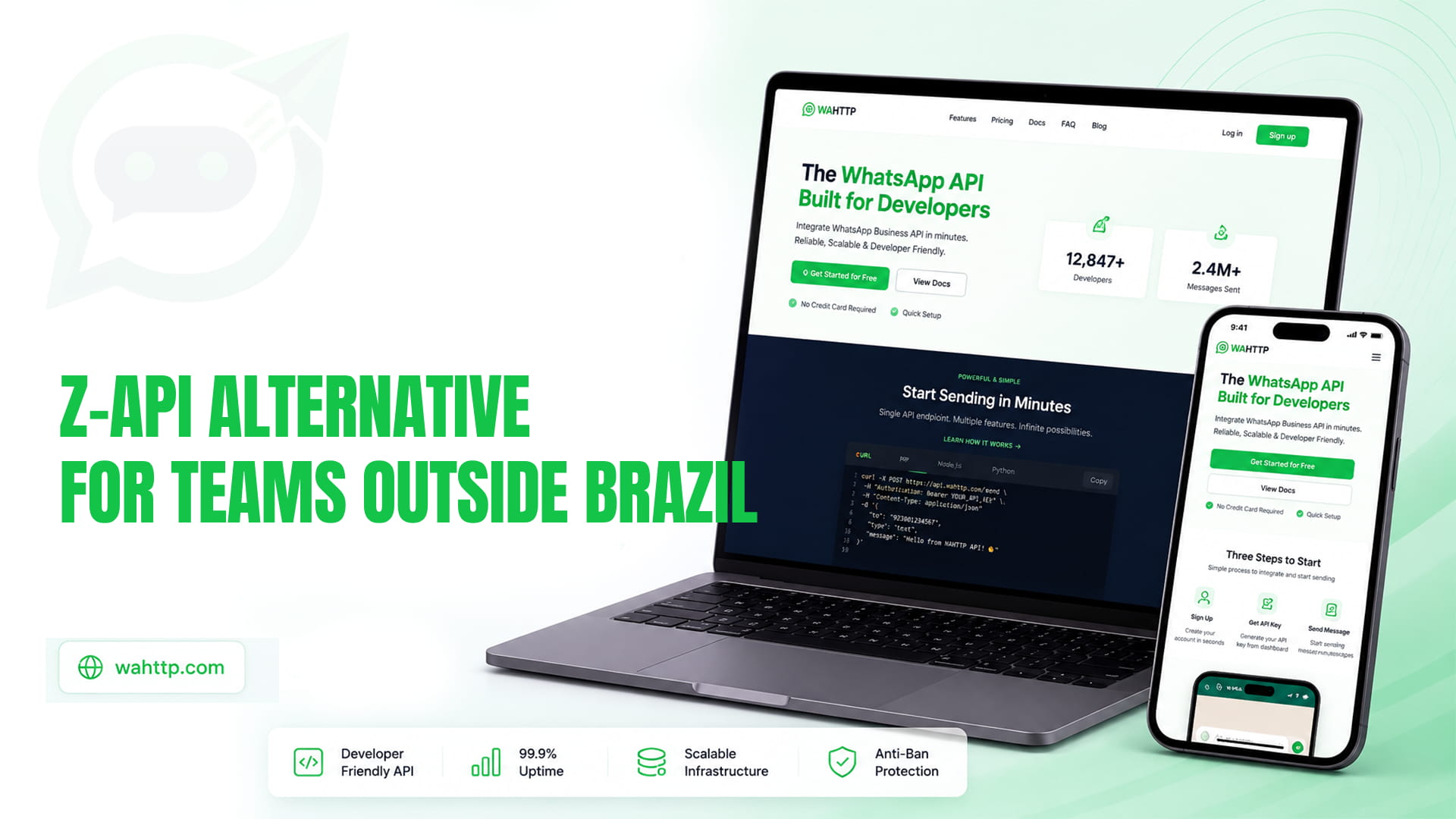
WaHttp, ours, so weigh accordingly. $5 for one session up to $35 for ten, unlimited messages throughout, plain REST endpoints, a Streamable HTTP MCP endpoint for AI agent integration, server-side pacing and signed webhooks. Dollar-priced, English-first, and newer to the market than Z-API, which is a fair thing to weigh against a provider with an established regional reputation.
Whapi.Cloud, more expensive at $35 per channel but the strongest option in the category if you specifically need Groups, Communities, Channels or Status automation, none of which Z-API's public feature list emphasises.
WAHA, self-hosted under Apache-2.0, dollar-cost-free beyond your own infrastructure, with previously paid features folded into the free image since version 2026.6.1. The right choice if currency exposure and vendor billing of any kind are both problems you would rather remove entirely, though it comes with the maintenance trade-offs of running anything yourself.
The wider landscape, official and unofficial, dollar and otherwise, is in our provider comparison.
What does not change by switching
Every provider named here, Z-API included, connects through the same unofficial WhatsApp Web protocol, which breaches WhatsApp's terms of service regardless of currency or country of origin. Restriction risk tracks your sending behaviour, not which of these vendors you route through, and no provider in this category can sell you immunity from it. If your actual goal is Meta compliance rather than simply avoiding Z-API's regional fit, the Cloud API comparison covers what that route costs and requires instead.
You also keep your number, your chat history and your contacts regardless of which provider you choose, since none of that data lives with any of these vendors.
Migration
Audit your integration. Z-API's endpoints for sending, receiving and webhooks map onto the same conceptual shape as any competitor: an instance identifier, a recipient, a message type, a body. Most integrations touch four or five endpoints, and listing them first usually shows the job is smaller than expected.
Remap your webhook handler. This is where the real work happens in any migration in this category. Payload structures differ between providers, so your inbound handler needs updating regardless of destination. If you already normalise incoming events into your own internal format, this is one function to change.
Move one instance first, particularly if you are running several. Migrate your lowest-stakes number, run it for a week against the new provider, then move the rest.
Re-scan the QR code. Sessions do not transfer between platforms. Each number needs relinking, roughly a minute per number, and this is the only interruption customers are likely to notice.
Warm up after relinking. A freshly authenticated session sits in a more fragile state for a week or two. Send at reduced volume rather than resuming full throughput immediately.
Overlap billing briefly. Keep the Z-API subscription active for a short window after cutover to confirm the new provider is stable before cancelling, particularly useful given Z-API's short two-day trial means you will not have tested the new provider for nearly as long as you have been running the old one.
Common Questions
How much does Z-API cost in US dollars? The Ultimate plan is R$99.99 per instance per month, which converts to roughly $19 to $20 at exchange rates in late 2026. That figure moves with the BRL/USD rate, which has varied substantially over the past two years, so treat it as an approximation rather than a fixed price.
Is Z-API available outside Brazil? The platform and an English version of the site are accessible internationally, and there is no technical restriction on using it from another country. The product is built and marketed primarily for the Brazilian market, which affects support orientation, billing currency and community documentation more than it affects raw functionality.
What is the best Z-API alternative for international teams? WasenderAPI and WaHttp both offer comparable functionality at lower dollar-denominated prices with English-first support. Whapi.Cloud is the better fit specifically for Groups and Channels automation. WAHA is the option if you want to avoid vendor billing in any currency.
Does currency exposure actually matter for a $20 a month subscription? At one instance, the absolute swing is small in dollar terms. It becomes more material at higher instance counts, where a percentage move in the exchange rate applies to a much larger total, and as a planning nuisance regardless of scale if your finance team budgets in a fixed currency.
Will I lose my chat history if I switch from Z-API? No. WhatsApp chat history, contacts and the number itself live on the phone and on WhatsApp's own servers, not with any API provider. You re-scan a QR code to link the number to a new platform.
Is Z-API a good product? By its own market's account, yes, with a strong reputation for stability and fast onboarding. The considerations in this article are about market fit and currency for teams outside Brazil, not about the underlying quality of the platform.
Does switching providers reduce WhatsApp ban risk? No. Every provider in this category, including Z-API, connects through the same unofficial protocol under the same WhatsApp terms of service. Restriction risk correlates with sending behaviour, not vendor choice or country of origin.